
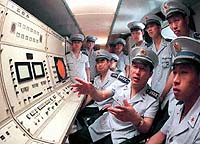
The People’s Republic of China persists in conducting a campaign of smoke and mirrors regarding its defense spending. The Beijing government has just announced that it plans to boost the defense budget by 12 percent in the coming year. That is a fairly hefty increase, and it continues a pattern of double digit hikes over the past decade. China’s neighbors in East Asia express growing uneasiness about that trend.
But far more troubling is Beijing’s continuing dishonesty about the overall extent of its military spending. According to the Chinese government, the defense budget last year was a paltry $22.4 billion. That figure would put China’s military spending far behind the levels of such countries as Japan, Germany, Britain, France, and Russia. However, anyone who believes that $22.4 billion is the actual extent of Beijing’s military outlays would be a prime candidate to buy a used bridge.
China’s official defense budget omits a few interesting items. Those include weapons purchases, military research and development expenditures, and a variety of personnel and other costs. According to the authoritative publication, “The Military Balance, 2003-2004,” published by the prestigious International Institute for Strategic Studies, the PRC’s actual military spending is more than $48 billion. Other credible estimates put the figure as high as $65 billion.
Why do Chinese leaders persist in presenting official figures that are so obviously fictional? The explanation may be as simple as communist bureaucratic inertia. All communist regimes tend to lie as a matter of principle. That habit may have persisted in China even as the officially communist system there has adopted economic policies more attuned to Milton Friedman than Karl Marx.
There may also be a matter of saving face. Having lied for years about the actual extent of military spending, the Chinese government would find it awkward at the very least to suddenly come up with accurate figures.
But there may be a less mundane and more troubling explanation. The refusal to divulge the real amount of military spending could be a clumsy attempt to conceal the scope of the effort to modernize China’s military. The PRC’s forces are certainly no match for those of the United States, but China has come a long way in the past decade from the antiquated, personnel-intensive “people’s army” conceived by Mao Zedong.
Beijing is trying to create a smaller but much more capable force — a true 21st century military apparatus. Among other things, the PRC has deployed more than 500 modern missiles across the strait from Taiwan, and it is purchasing first-rate fighter planes from Russia. Most ominously, China is trying to strengthen its capability to strike at U.S. naval forces deployed in the western Pacific. Purchases of the sophisticated Sunburn anti-ship missiles from Russia clearly point to that objective.
It is unlikely that China is attempting to challenge America’s global military dominance. That would be an utterly unattainable objective for at least another generation. It is possible, though, that Beijing may have more limited but equally troubling goals. Is the PRC attempting to create a modern military force capable of intimidating Taiwan (as well as other neighbors in East Asia) and discourage the United States from honoring its security commitments in the region because the prospect of confronting China would be both too costly and too dangerous?
There are no certain answers to that question, but Beijing’s ongoing falsification of its defense budget breeds suspicions. If the PRC wants to allay such suspicions about its motives, it needs to come clean about the real level of its military spending. The United States and the nations of East Asia are entitled to expect nothing less from a responsible member of the international community.
