
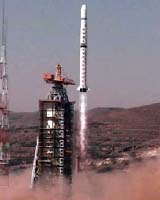
China will launch more spacecrafts next year, including the famous Shenzhou 6 spaceship, China’s second manned spacecraft.
The year 2004 has marked great progress in China’s space industry. 8 domestically-designed “Long March” series carrier rockets have been launched and 10 satellites have been sent onto preset orbits, which is a historical record.
Liu Zonglin, a representative of China Aerospace Science and Technology Corporation says up until now, China has launched a total of 83 “Long March” series carrier rockets with a 93% success rate.
“Accurate plans, improved launching programs and testing techniques are the main factors in China’s successful launch of rockets. Meanwhile, the successful launch is also a mark that the quality of Chinese series carrier rockets and the project administration have been greatly enhanced.”
Currently, there are 12 types of “Long March” carrier rockets and they can meet the launch demands of every kind of spacecraft onto various different orbits.
Liu Zonglin is optimistic that research on a 13 type is progressing smoothly and some breakthroughs have already been made.
In addition to the rockets, China sent the greatest number of satellites with different uses into space this year. Some are being used for scientific experiments and others to obtain weather information.
On the back of these successes in the space industry, China is planning to launch more spacecrafts in 2005. The most eye-catching of these is the Shenzhou 6 spaceship, China’s second manned spacecraft.
Yuan Jiajun, the director of the Chinese Academy of Space Technology says the Shenzhou 6 will carry 2 astronauts for a five-day space flight.
“The Shenzhou 6 spaceship will face much challenges in adapting to the space environment and in protecting the astronauts. The researchers of manned aerospace must make careful plans to guarantee success.”
Yuan Jiajun says that up to now, the research and manufacturing of the Shenzhou 6 spaceship has gone smoothly.
