
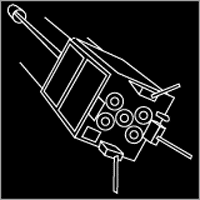
China is setting its sight to compete in the microsat international market. Two recent announcements made clear indication that the country wanted to establish its presence in the booming market.
Last month the Harbin Industrial University announced that engineering research was well underway to complete China’s first microsat, according to a report in the Harbin Daily on May 30.
Harbin Industrial University leads the effort in researching and developing microsat in China. In 1997 the university assembled a team of more than 30 researchers and technicians from various disciplines to come up with a unified integrated technology system for building a microsat.
The proposed system received approval in July 1998. Since then the team moved on to the stage of engineering research and prototyping.
On a separate front, both the official Xinhua News Agency and the People’s Daily reported in the past two days that a new company had been set up here recently to develop and market microsat and detector technologies.
The company, the Aerospace Tsinghua Satellite Technology Co. Ltd. (ATST), received an official sanction from the State Administration of Industry. Financial backing came from the China Aerospace Machinery and Electronics Corporation, the Tsinghua University Enterprise Group, and the Tsinghua Tongfang Co. Ltd.
This is the first time the high-tech aerospace industry collaborates with a well-established university to fund and share resources in a joint business venture.
The company will focus on developing microsats and detector technologies, and marketing their applications.
The research and development in this field will create innovative technologies and experiments. Applications of the innovation include surveying resources, forecasting natural disaster, mapping and exploration, monitoring environment and agriculture, navigating and positioning, transmitting information and communications, and reconnaissance of the national border for unexpected events.
In addition to developing new aerospace products, the collaboration with a university will also nurture new talents.
ATST will also cooperate with the newly-formed company Space Solid Fuel Rocket Carrier Co. Ltd. (SSRC).
When SSRC was set up a month ago, it announced that the solid fuel rocket would target delivering microsats into space. The cooperation between the two companies will strengthen China’s ability to gain a foothold in the expanding market of low-cost satellites.
