

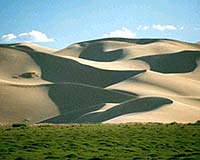
China’s seemingly ever-expanding deserts have in recent years shrunk for the first time, the government said Monday, although the amount of land saved from an arid fate was relatively modest. The nation recorded an average net shrinkage of its deserts of 1,283 square kilometers (495 square miles) per year since the beginning of the decade, said State Forestry Administration director Jia Zhibang.
“It’s the first time since the people’s republic was established (in 1949) that we have brought about a reversal,” Jia told a briefing in Beijing.
The shrinkage in recent years compares with an average net annual increase of China’s deserts of 3,436 square kilometers in the second half of the 1990s, according to Jia.
Giant sandstorms emerging from China’s vast northern deserts are known to have been carried across the Pacific to the western part of the United States.
The reversal is partly a result of intensified efforts to plant more trees, Jia said.
In the past five years, the percentage of China’s land area covered by forest has increased from 16.6 percent to 18.2 percent, and the government hopes to raise that figure to 20 percent by 2010, Jia said.
Figures cited by the state-run Xinhua news agency Monday showed that China had planted more than 12 billion trees since 2001, or nearly 10 trees per citizen.
However, the current annual decline of desert area appears marginal against the overall numbers.
China still has 2.6 million square kilometers (1 million square miles) of desert, or nearly 2.5 times the country’s total farmland, previously released government statistics show.
More than a quarter of China’s total land area has been classified as desert and the degradation is adversely affecting the lives of more than 400 million people, or 30 percent of its population, according to the statistics.
Source: Agence France-Presse
