
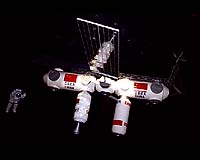
A Chinese scientist declared last week that China would orbit its own space station in 25 years, the newspaper Wuhan Evening News reported last Wednesday (Sept. 11).
“Twenty-five years later, our country would also complete a space station,” said Ye Shuhua, a scientist with the Chinese Academy of Sciences (CAS).
Ye made the comments last Tuesday (Sept. 10) during an academic forum on astronomy, geodesy and geodynamics that was held in Wuhan, the capital of Hubei Province.
Wang Qi, a researcher with the provincial branch of the China Seismological Bureau, added that the space station could have science instruments such as an astronomical telescope and a remote sensing radar installed.
Wang said further: “People could live and sightsee on it, just like taking up accommodation in a space hotel, and also conduct all kinds of experiments to explore the mystery of nature and unveil causes of environmental disasters.”
Chinese space officials have said on many occasions that the nation would follow the course of achieving manned spaceflight, then an orbiting space laboratory that would eventually lead to a permanent space station with yuhangyuans (“astronauts”) living and working aboard.
China’s first ever long-range space plan, the so-called “White Paper” that the government issued in November 2000, also outlined the three-stage approach. The long-range space plan calls for attaining manned space operation capability by the end of this decade.
However, a timeline to establish the space station is very vague in both the long-range space plan and in the words of Chinese officials.
Chinese Space Tourism?
Although Wang alludes to the scenario of tourists on the Chinese space station, China does not appear to have any short-term plan on developing space tourism when it reaches the manned spaceflight capability. But in the long-term, China has not dismissed such a possibility.
In an article that China Spatial Information published last year, an unidentified specialist at the Beijing Institute of Space Machine and Electricity, also known as the 508 Research Institute, explained that several factors would affect the development potential of Chinese space tourism.
According to the unnamed specialist, the more important factors would be whether the government would allow such an enterprise, the general population would be able to afford the price of a space tour, and the limited size of the Shenzhou manned spacecraft.
“The carrying capacity of the cosmic spacecraft [Shenzhou] is small. If used in tourism, increasing the capacity would definitely result in a new design to the spacecraft. This is an enormous expenses,” said the specialist.
But the specialist said that in long-term view, public getting into space for a visit would be a development trend in the space industry.
The specialist predicted: “The time when people of China ride their own spacecraft to do sightseeing in space will come too.”
