
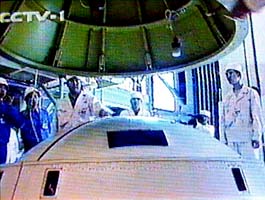
China’s first space materials and environmental engineering laboratory opened last month in Harbin, the official Chinese news agency Xinhua reported.
Located in the Harbin Industrial University in northeastern China, the laboratory has a large-scale integrated space radiation simulation system, and a space material vacuum and thermal cycle simulator. Both facilities can be used in integrated or standalone simulation.
The units simulate high vaccum and electron irradiation within the space environment. They allow researchers to systematically research on space materials and evaluate critical component elements, select appropriate materials and techniques to combat environmental damages in space.
Space material and environmental engineering is important and fundamental in space technology development. During on-orbit operations, a payload is affected by extreme environmental factors such as high vacuum, ultralow temperature, and radiation from the Sun and the Earth’s ionosphere and Van Allen radiation belt.
These environmental factors can cause damages to materials and critical system components, which lead to failure of the payload. Studies in space environment and its effects on materials provide theories and practical techniques in minimizing and preventing payload failure.
University professor and laboratory academic committee member Yang Dezhuang said that preparation to build the laboratory began in 1996. The laboratory is also a training ground for advanced space material specialists. Presently there are 32 professors and Ph.D. students working in the laboratory.
China News Today
