
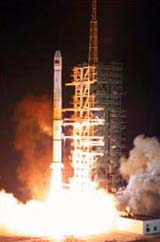
The official Chinese news agency Xinhua announced Wednesday that a Long March-3A rocket has successfully launched a telecommunications satellite in the early morning of Jan. 26.
At 45 minutes past midnight Beijing time, a Long March-3A launcher lifted off from the Xichang Satellite Launching Center (XSLC) in Sichuan Province, southwest China. The rocket placed the Zhongxing-22 comsat (Zhongxing means “China Star”) in its planned orbit.
The satellite reached a geostationary transfer orbit (GTO) thirty minutes after launch, with a perigee of 210 km and an apogee of 41,974 km. Tracking of the flight was carried out at the mission control centre at XSLC and through the Yuanwang tracking ship network. The final orbital position of Zhongxing-22 is 98 degree east longitude above the Equator.
Since its debut in 1994, LM-3A had made four flights; including the launch today. In the three previous flights, the rocket delivered two Dongfanghong-3 telecommunications satellites (Dongfanghong means “East is Red”) and the science satellite Shijian-4 (Shijian means “Practice”), which studied solar radiation and its interaction with the Earth’s magnetosphere.
The liftoff today is the 60th launch of the Long March family of rockets, and is the 18th consecutive successful launch of Long March rockets since October 1996. The Chinese Academy of Rocket Technology develops and builds the LM-3A. The rocket has a liftoff mass of 243,000 kg and a GTO payload capacity of 2,600 kg.
The Zhongxing-22 geostationary comsat, developed and built by the Chinese Academy of Space Technology, weighs 2,300 kg and has a life expectancy of eight years. The China Telecommunications and Broadcasting Satellite Corporation is responsible for its business operation.
In other news, the China News Service reported on Monday (24th) that the Shanghai Bureau of Astronautics would set its goal of “two rockets two satellites” for this year. The Bureau aims at participating in the production and use of two types of Long March vehicles and orbiting satellites.
The two types of launchers are the LM-3 and LM-4B, and the two types of satellites are the Fengyun meteorological satellite (Fengyun means “Wind and Cloud”) and the new generation of recoverable remote sensing satellite.
According to personnel involved in the projects, the goal includes:
- LM-3 launch of a geostationary orbit Fengyun-2, which will replace the defunct Fengyun-2A that was launched in 1997.
- LM-4B launch of the next generation recoverable remote sensing satellite.
- Launch of a sun-synchronous orbit Fengyun-3, the next generation metsat that will replace the operational Fengyun-1.
