
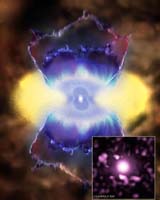
Astronomers have found powerful X-ray-producing regions located around two quasars that could have powered their activation. If so, the discovery could help scientists understand how the distant, mysterious quasars ignite.
Using NASA’s Chandra X-ray Observatory, the team found the features located tens of thousands of light-years from supermassive black holes at the centers of the galaxies in question.
“The X-ray features are likely shock waves that could be a direct result of the turning on of the quasars about 4 billion years ago,” said lead researcher Alan Stockton of the University of Hawaii.
Since the discovery of quasars for quasi-stellar objects in the early 1960s, astronomers have been trying to understand the conditions surrounding the birth of these immensely powerful constituents of some galaxies which can outshine entire galaxies.
The two quasars 4C37.43 and 3C249.1 – showed no evidence of being surrounded by a much larger envelope of hot gas, and the astronomers did not observe X-ray regions associated with radio waves from the quasars themselves. These factors rule out possible explanations for the X-ray-emitting clouds, such as the cooling of hot intergalactic gas or heating by high-energy jets from the quasars.
“The best explanation for our observations is that a burst of star formation, or the activation of the quasar itself, is driving an enormous amount of gas away from the quasar’s host galaxy at extremely high speeds,” said co-leader Hai Fu, also from UH.
T Tiziana Di Matteo of Carnegie-Mellon University in Pittsburgh, Pa., and colleagues created computer simulations that closely match the observations. The simulations depict the formation of stars and the growth of black holes during a collision between two galaxies. The collision drives gas toward the central regions, where the gas triggers a burst of star formation and provides fuel for the growth of a central black hole.
The simulations also show that when the inflow of gas into the black hole releases a tremendous amount of energy, a quasar is born. The power output of the quasar dwarfs that of the surrounding galaxy and expels gas in what has been termed a galactic superwind. The new Chandra data provide the best evidence yet that the quasar-produced superwind in the simulations is valid.
Writing in The Astrophysical Journal, the team said the data show that over a period of about 100 million years, the superwind will drive all the gas away from the central regions of the galaxy, quenching both star formation and further black hole growth. The quasar phase will end and the galaxy will settle down to a relatively quiet life.
