
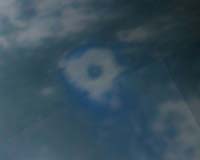
The Cassini spacecraft has seen a 50-mile-diameter impact crater on Titan with different instruments on separate flybys, giving scientists new information on impact-crater formation on Saturn’s giant moon.
They’ve released a composite image of one of Titan’s most prominent impact
craters as previously seen by Cassini’s radar and recently seen by its
Visual and Infrared Mapping Spectrometer (VIMS).
The radar image was taken during the Cassini spacecraft’s Feb. 15, 2005
Titan flyby, and the VIMS images were taken during its April 16, 2005 Titan
flyby, said Robert H. Brown of The University of Arizona, head of the VIMS
experiment.
Brown released the composite image at the European Geosciences
Union meeting in Vienna, Austria, on Monday (April 25).
The crater seen on Titan by both radar and VIMS is more than 50 times
larger than Meteor Crater in northern Arizona.
In radar, the crater and its ejecta blanket are bright. In radar, brighter
surfaces mean rougher terrains, or else terrains tilted towards the radar.
At VIMS infrared wavelengths, the crater appears dark and the ejecta
blanket is bright, showing that the crust on the crater floor is different
material than the ejecta.
“The composite image highlights the differences and similarities in how
two instruments see the same thing,” Brown said.
“It shows the power of combining instruments when you are trying to understand objects in the Saturnian system.”
VIMS is essentially a camera that takes pictures in 352 different colors at
the same time. The colors cover the visible spectrum and into the infrared,
or from three-tenths of a micron up to five and one-tenth microns. (A
micron is one millionth of a meter.) Scientists can identify the chemical
composition of the surfaces, atmospheres and rings of Saturn and its moons
using VIMS.
Cassini began a 4-year-or-more exploratory tour of the Saturn system in
July 2004. It has seen two impact craters on Titan so far.
