
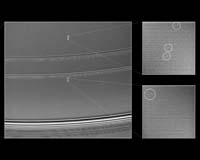
Cornell University astronomers report finding four small, embedded moonlets among propeller-shaped disturbances in Saturn’s A ring a finding that suggests the planets ring system could harbor millions more such objects.
The discovery marks the first evidence of moonlets that bridge the size gap between Saturns larger ring moons Pan and Daphnis (which are several miles each in diameter), and much smaller ice particles that scientists think comprise the bulk of the giant rings.
“The discovery of these intermediate-sized particles tells us that Pan and Daphnis are probably just the largest members of the ring population, rather than interlopers from somewhere else,” said lead researcher Matthew Tiscareno.
Tiscareno and colleagues describe their finding in the March 30 issue of the journal Nature.
The four disturbances, which appear as pairs of slightly offset bright horizontal streaks in an otherwise bland region of the ring, actually were captured in two images taken in 2004 by NASA’s Cassini spacecraft. The Cornell team said the streaks are indicators of orbiting moons about 100 meters (328 feet) in diameter, or about the length of a football field.
The moonlets are too small for Cassini’s highly sensitive Imaging Science Subsystem to see directly, yet they are large enough to exert an observable gravitational pull on the particles around them.
If scientists confirm the existence of a continuum of particle sizes within Saturns rings, it would lend strong support to the hypothesis that Saturn’s rings were formed when another object fragmented by moving too close to the planet, breaking into pieces which were then captured by Saturn’s gravitational pull.
“There has always been the question about whether the rings were primordial material that was unable to grow into a moon or debris left over from a breakup event,” said co-author Joseph Burns.
The discovery does not completely rule out the accretion model, but “it’s a step in that direction,” said Tiscareno. “It’s hard for direct accretion to produce particles this large. It’s much easier if you start with a solid icy core, like a shard from a breakup.”
The finding also helps explain fully cleared openings in the rings, such as the Encke and Keeler gaps. The gravitational influence of a larger moon like Pan or Daphnis wraps around the circumference of the rings, creating a gap. The smaller moonlets begin to create this effect, the researchers say, but their influence is not strong enough to prevent particles from falling into the rings ahead of and behind them.
Like a motorboat’s wake on a smooth lake, the four observed disturbances are particularly visible because the area they inhabit is relatively smooth. Nevertheless, the fact that four moonlets were found in just two images covering only a tiny fraction of the ring makes it likely that millions more exist. By studying them further, the researchers said they hope to gain a better understanding of how Saturn’s rings formed – and even about how solar systems form around stars.
“The structures we observe with Cassini are strikingly similar to those seen in many numerical models of the early stages of planetary formation, even though the scales are vastly different,” said Carl Murray, another co-author and astronomer at Queen Mary College at the University of London. “In this way, Cassini is giving us unique insight into the origin of planets.”
