
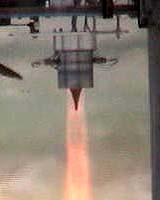
A team from California State University, Long Beach (CSULB), in partnership with Garvey Spacecraft Corporation (GSC), successfully conducted a static fire test of a 1000 lbf ablative annular aerospike rocket engine in the Mojave desert on June 21, 2003 using LOX and ethanol propellants.
This test represents an important milestone in the team’s efforts to ultimately perform the first powered flight test of such a liquid-propellant aerospike engine.
Aerospike engines have received considerable attention by NASA, Rocketdyne and other aerospace organizations over the last forty years because of potential performance advantages over conventional rocket engines equipped with bell-shaped nozzles.
These features are particularly attractive for single-stage-to-orbit vehicles. NASA attempted to address important research questions about linear-shaped aerospike engines through the X-33 project, as well as a precursor series of tests using an SR-71 Blackbird.
However, the X-33 was terminated before ever reaching the flight stand, while aerospike tests with the Blackbird never reached the point where the engine was turned on.
Since then, government-supported research in this field has dropped off significantly. The only other recent reportable progress has been that of a Utah company, JP Rocket Engines, which accomplished the first flight of a non-liquid-propellant aerospike by using a modified, commercially available consumer rocket motor.
The CSULB/GSC partnership is conducting its own research into aerospike engines to support the development of future advanced launch systems, while also providing hands-on mentoring to the aerospace engineering students who may someday actually build these vehicles.
The team is now shifting its focus to its own upcoming aerospike flight test. It will utilize the school’s Prospector 2 (P-2) vehicle, which was flown and recovered intact in early 2002. GSC, which developed the basic vehicle design for academic-oriented test applications, will handle the field operations in conjunction with the RRS.
These two organizations have extensive experience in low-cost, pioneering launch vehicle testing, as best reflected by their first-flight demonstration of a composite LOX tank supplied by Microcosm, Inc. in 2000.
Tentative plans call for an initial launch attempt of the P-2 with the refurbished CSULB aerospike engine later this summer.
