
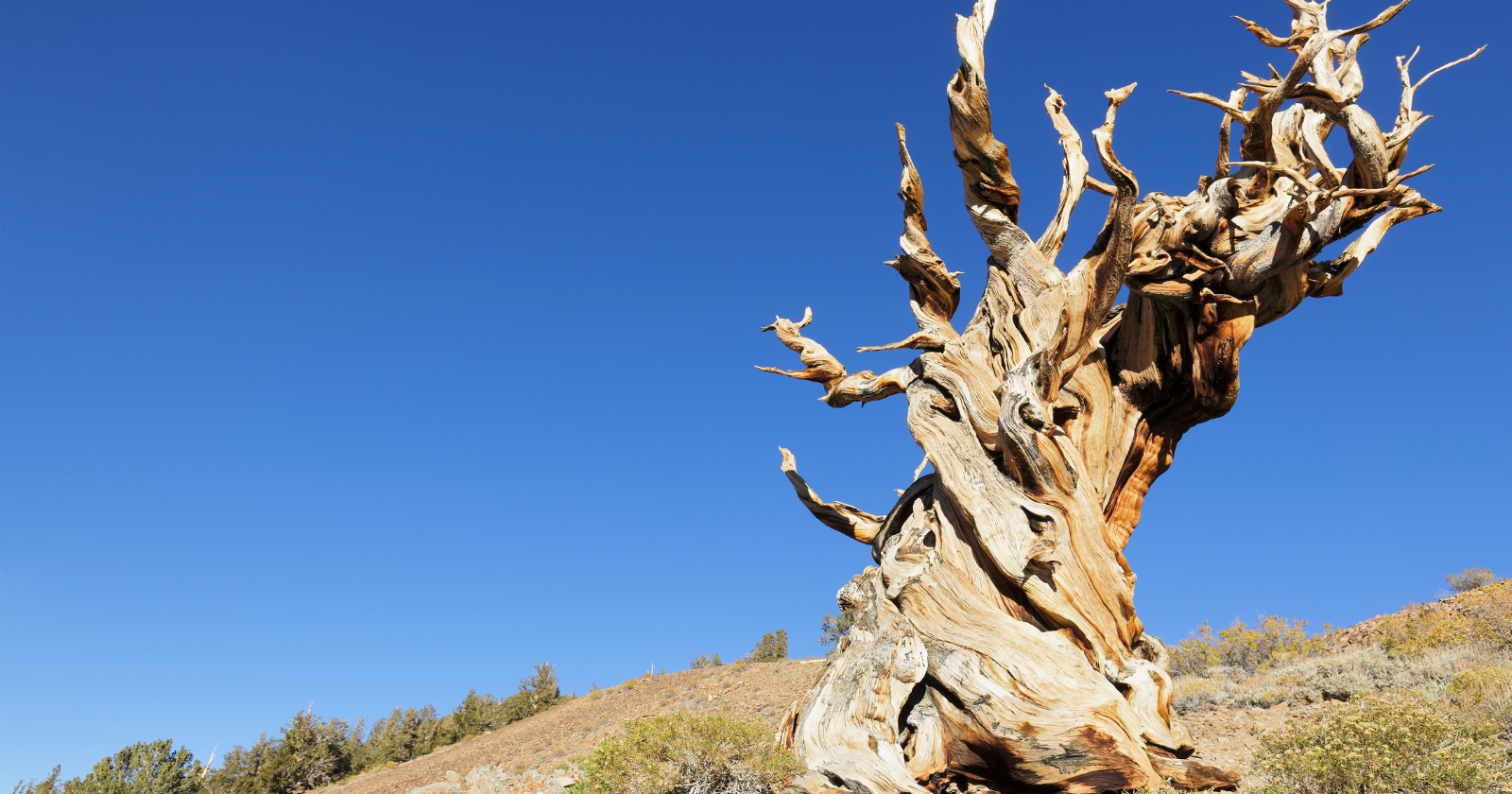
Methuselah, a Great Basin bristlecone pine in the White Mountains of eastern California, has been alive somewhere between roughly 4,668 and 4,857 years. The disagreement is real, but bounded by ring counting, and the tree was certainly already growing on the slopes of the Whites before the Great Pyramid of Giza was built. On the most commonly cited age estimate, it germinated around 2832 BC. The Old Kingdom of Egypt had not yet started.
The tree stands at about 3,000 metres elevation in the Ancient Bristlecone Pine Forest in Inyo National Forest. It is not a giant. In the harsh high-elevation zones where the oldest bristlecones live, many stand closer to weathered sculptures than forest trees. The exact location is not made public. Forest Service rangers do not point it out on the trail. Visitors walk past it.
Bristlecones are old in a specific, mechanical way, and the mechanism is reasonably well understood.
What grows them slowly
Conditions at tree line in the Whites are unforgiving. Short growing seasons, nutrient-poor dolomitic soils, cold, dry air, high winds. According to the National Wildlife Federation, a 40-year-old bristlecone may stand less than six inches tall. In the hardest years, the rings can be so thin that counters cannot find one at all, suggesting the tree simply did not grow.
Slow growth produces dense wood. Dense, resinous wood resists fungi, insects, and rot. Exposed dead wood on living trees does not decompose in the usual sense; it erodes, slowly, in wind and freeze-thaw cycles. Branches die. Sections of trunk go bare. Threads of living tissue keep going up between weathered grey stretches of the same trunk.
Most trees die because something rots them, eats them, or burns them. Bristlecones make wood that resists rotting and eating, and they grow in places where there is not much fuel to burn. The high ratio of dead wood to live wood reduces respiration and water loss. The result is a tree that accumulates years without obvious upper bound.
According to UC Davis’s announcement of the species’ genome sequencing, one theory is that bristlecone pines may not senesce in the usual biological sense. They do not appear to show the same clear signatures of ageing seen in many organisms, though researchers caution that the idea can be overstated. What is safer to say is that these trees usually die from outward forces, such as drought, storm, insects, fire, or an axe, rather than from a simple internal clock running out.
How the age is known
The dating work is largely traceable to one researcher. Edmund Schulman, a dendrochronologist at the University of Arizona’s Laboratory of Tree-Ring Research, was searching for the oldest trees in the Whites through the 1950s. In 1957, with his assistant Tom Harlan, he sampled what he believed to be the oldest of them, named it Methuselah, and reported a ring count of 4,789 years at the time of coring.
Schulman died the following year. The chronology has been continued and extended by other researchers in the same lab, including Matthew Salzer, whose own age estimate for Methuselah is closer to 4,668 years, owing to a missing core sample that prevents full reproduction of Schulman’s original count. The discrepancy is small against the tree’s life. It is not small against current dendrochronological standards.
There is also Prometheus. In 1964, a graduate student named Donald Currey was trying to date another ancient bristlecone on Wheeler Peak in Nevada. After difficulty getting a usable core sample, and with Forest Service permission, the tree was cut down. The ring count showed it had been nearly 5,000 years old.
The wider use of the rings
The bristlecone chronology assembled from living trees, dead standing trees, and fallen wood now stretches back more than 10,000 years. The wood does not rot fast enough for the record to be lost.
That chronology has been used to calibrate radiocarbon dating. Carbon-14 measurements of organic material can be cross-checked against rings of known calendar age, which has sharpened the dates of Egyptian tomb wood, early agricultural sites, and a long list of archaeological samples. The trees are also a 10,000-year proxy record of temperature, precipitation, and volcanic eruption events in that one high, dry place.
The dead wood on the slopes of the Whites holds rings that predate any living tree. Researchers are still sampling it.
What is changing now
According to a 2009 paper in the Proceedings of the National Academy of Sciences led by Salzer and his colleagues, bristlecones at the upper tree line in the Whites have been growing faster over the past fifty years than at any point in the previous 4,000 years of the chronology. Trees at lower elevations did not show the same pattern. The study reads the upper-tree-line acceleration as consistent with warming temperatures relaxing the cold-limit constraint on growth.
The wider picture is less clean. According to a 2022 paper in Nature Climate Change led by Park Williams of UCLA, the western United States is in what the study describes as the worst multi-decade drought in roughly 1,200 years. Bristlecones near Methuselah have died from it. Bark beetles, historically slowed by the cold, have been observed at higher elevations than before. The species that has outlasted dynasties grows inside a relatively narrow climate window.
The window is shifting around it.
