
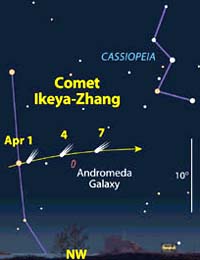
Amateur astronomers throughout the Northern Hemisphere have marked Thursday, April 4th, on their calendars. That evening, weather permitting, they’ll be looking low in the northwest after sunset to spot a bright comet very near the famous Andromeda Galaxy. The comet, which was discovered on February 1st, is named Ikeya-Zhang [pronounced “ee-KAY-uh JONG”] for the two keen-eyed skygazers who first spotted it.
Remarkably, both the comet and the galaxy are visible to the unaided eye — at least for anyone with clear, dark skies far from the pall of city lights. The view through binoculars or a small telescope should be especially rewarding, as these two celestial spectacles crowd into the same field of view.
According to Sky & Telescope magazine, on that evening the comet passes within 1.5 degrees of the galaxy’s center. Comet Ikeya-Zhang will then be 82 million kilometers (51 million miles) from Earth, while the Andromeda Galaxy lies 300 billion times farther away (2.5 million light-years).
Even though it passed closest to the Sun on March 18th, Comet Ikeya-Zhang has remained steady in brightness for the past two weeks, delighting skywatchers with its starlike nucleus and delicate, wispy tail.
