
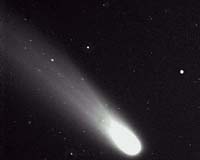
The brightest comet since 1997’s Hale-Bopp is currently gracing the western skies of North America. Comet Ikeya-Zhang (pronounced “ee-KAY-uh JONG”) was discovered on February 1st by two amateur astronomers in Japan and China, respectively.
Calculations of the comet’s orbit by Brian Marsden of the Harvard-Smithsonian Center for Astrophysics show that it was last seen in 1661. This makes Ikeya-Zhang the first long-period comet (a comet with a period longer than 200 years) to be identified on its return to the inner solar system.
No telescope is necessary to look at this beautiful visitor as it swings around the Sun and heads back to deep space. The comet has brightened to naked-eye visibility, but is easiest to see through binoculars.
