
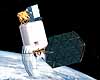
Boeing has won a four-year, $48 million contract from the U.S. Air Force Research Laboratory at Kirtland Air Force Base, N.M., to develop a solar orbit transfer vehicle. The sun-powered vehicle will transfer payloads from one orbit to another and produce electric power once on orbit.
In performing the contract, Boeing Phantom Works will design, develop,
integrate and demonstrate a Solar Orbit Transfer Vehicle (SOTV) space experiment as a valid step in the development of an operational SOTV.
“We believe the development of solar thermal propulsion technologies
will significantly benefit future space missions,” said Ed Cady, Phantom
Works SOTV program manager. “This contract is a stepping stone towards
answering a U.S. Air Force requirement – reducing the high cost of launches.”
“The space community has long searched for feasible technology that
helps reduce the cost of space access,” said Michael Jacox, U.S. Air Force
SOTV program manager. “The continued pursuit of a more efficient propulsion
system has been driven largely by the fact that current launch vehicles
transport less than one percent of their initial ground launch mass into
GEO [geosynchronous equatorial orbit].”
Today, payloads move from one orbit to another by using attitude control
propellants on the satellites, often sacrificing years of operational life
in the process.
The proposed solar orbit transfer vehicle design uses an advanced solar
thermal propulsion engine to provide both propulsion and electric power
for the SOTV space experiment.
“Our Solar Orbit Transfer Vehicle program will be a four-year effort
to conduct a space experiment involving revolutionary solar energy propulsion and power technology and to mature it through research and ground demonstrations,” Jacox said. Cady added that the use of solar energy to heat the hydrogen propellant is expected to lower the cost of space lift in an operational solar orbit transfer vehicle.
“The vehicle can transfer 50 to 100 percent more payload to GEO than
current chemical thruster systems,” Cady said. “The SOTV specific impulse
of 800 seconds is roughly twice that of chemical propulsion. This propulsion
system generates relatively low thrust, necessitating 20 to 30 days to
travel from low earth orbit to GEO. Once on-orbit, however, the same system
used for propulsion could provide kilowatts of power for seven years or
more.”
The space experiment program follows the successful completion of an
engine ground demonstration at the NASA Lewis Research Center. A prototype
engine was operated at temperatures above 2100 K (Kelvin) in the summer
of 1997.
The program is intended to complement the capabilities of launch vehicles
such as Delta III and EELV (Evolved Expendable Launch Vehicle). The space
experiment’s first flight will be October 2001 as a secondary payload on
an early EELV flight.
The Boeing Phantom Works business unit specializes in finding solutions
to military and commercial problems. The solar orbit transfer vehicle is
an innovative solution to reducing the cost of delivering payloads from
one orbit to another.
