
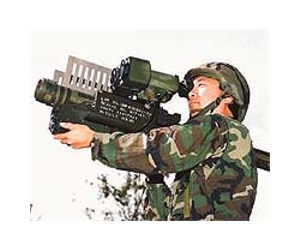
Despite a million dollar buyback program and hundreds of raids on illicit weapons caches, US and Iraqi forces are still uncovering surface-to-air missiles in insurgent stockpiles. US military press releases and media reports reveal that, since October 2006, at least 121 such missiles have been recovered, along with 4 additional launchers and various components.
These reports suggest that insurgents still have ready access to surface-to-air missiles, including MANPADS, at least some of which are reportedly still operational. The missiles pose an immediate threat to civilian and military aircraft in Iraq and a potential threat to aircraft in the region.
An analysis of data collected from US military and media sources reveals much about the illicit surface-to-air missiles in the hands of insurgents. Before summarizing these findings, however, it is important to note the limitations of the data.
Not all raids on illicit arms caches are reported to the public, and those that are often lack key details, including the number and types of recovered missiles, their condition and their likely origin. Furthermore, at least one item initially identified as a surface-to-air missile turned out to be a different type of weapon entirely.
Documents released in response to a Freedom of Information Act (FOIA) request filed by the FAS reveal that a “surface-to-air missile launcher and platform” seized from an arms cache north of Muqdadiyah in December 2007 was actually a home-made rocket-propelled grenade launcher .
The FAS has filed FOIA requests for additional information on other missiles recovered in Iraq and will update these findings to reflect the contents of any responsive documents.
The prevalence of Warsaw Pact missiles is not surprising given that Saddam Hussein’s regime stockpiled thousands of SA-7s, SA-14s and SA-16s, and that hundreds, possibly thousands, of these missiles were looted from government depots after the regime collapsed in 2003.
These reports are also consistent with public knowledge of the global inventory of illicit MANPADS, the majority of which appear to be SA-7 and SA-14 missiles.
This is good news in that the SA-7s and the SA-14s could be nearing the end of their shelf life (depending on when they were manufactured and how they were stored) and are less capable than their third and fourth generation counterparts.
Yet even first generation missiles can be effective, as evidenced by the November 2003 shoot downs of a Chinook transport helicopter that killed or injured 36 soldiers and a DHL A300 cargo aircraft, the crew of which was forced to perform a harrowing throttles-only landing after their plane was hit by an SA-7 as it was departing from Baghdad International Airport.
While apparently much smaller in number, missiles produced by other countries – namely Iran – have also been discovered in Iraq. During a September 2007 press conference, RDML Mark Fox reported that “in recent months, we have seen Iran smuggle advanced weaponry into Iraq…including the Misagh-1 [man-transportable] surface-to-air missile.”
This is the second public report of an Iranian MANPADS in Iraq since 2004, when Coalition forces reportedly found an abandoned Misagh-1 near Baghdad International Airport.
Also notable is the apparent absence of western missiles in Iraq. To date, there has not been a single report of an illicit US, British, French, or Swedish MANPADS in Iraq. This is also consistent with global trends and is probably explained by a variety of factors.
Western MANPADS are less numerous and widely proliferated than the ubiquitous SA-7, which has been exported to at least 71 countries, according to Jane’s Information Group.
Western governments are also, generally speaking, more discriminating regarding whom they sell MANPADS to and what they demand of importers. The US, for example, conducts annual 100% on-site physical inventories by serial number of nearly all exported Stinger missiles.
That is not to say that Western MANPADS have never been diverted into the black market; the CIA lost control of hundreds of Stingers, Blowpipes and SA-7s that it distributed to the Mujahideen in the 1980s, and dozens of Swedish RBS-70 missiles were reportedly diverted to Iran in the mid-80s.
But the apparent absence of Western missiles from insurgent arsenals in Iraq and elsewhere in recent years does suggest that current US and European export controls on MANPADS are fairly effective. It is also important to note that some of the unidentified surface-to-air missiles may not be man-portable.
Documents released in response to a FOIA request filed by the FAS in 2007 revealed that a cache of “22 surface-to-air missiles” seized by US forces north of Baghdad in January 2006 were not MANPADS but 73-kg SA-13 Gopher short-range, low-altitude surface-to-air missiles.
The FAS has filed similar FOIA requests for information about several of the unidentified missiles identified above and will notify Missile Watch readers when responsive documents are received. While the reports show that illicit surface-to-air missiles are still relatively widespread in Iraq, the data tell us little about actual number of illicit missiles still in circulation.
Even though the number of missiles seized over the past two years has held steady (sixty-six from 10/06-9/07 and fifty-nine from 10/07 to 10/08), it is possible that the total number of missiles in circulation is much lower than in previous years and that a larger percentage of the missiles that remain are being recovered as a result of stepped-up neighborhood patrols.
According to the Brookings Institute, seizures of caches increased from 2,660 in 2006 to 6,969 in 2007.
Less ambiguous is the decrease in crashes resulting from missile attacks and other ground fire. Despite the continued presence of illicit MANPADS and other small arms in Iraq, the number of successful attacks has declined significantly over the past year.
According to data compiled by the Brookings Institute, not a single helicopter has been lost to hostile fire in the last twelve months, and the last spate of deadly shoot downs was nearly two years ago.
This decline is probably explained by several factors, including tactical adjustments made after a spate of deadly attacks in early 2007.
The threat persists, however, as evidenced by reports of missile launches at a C-130 cargo plane carrying a Congressional delegation in August 200718 and at an Apache helicopter flying over Sadr City in May 2008.19
