
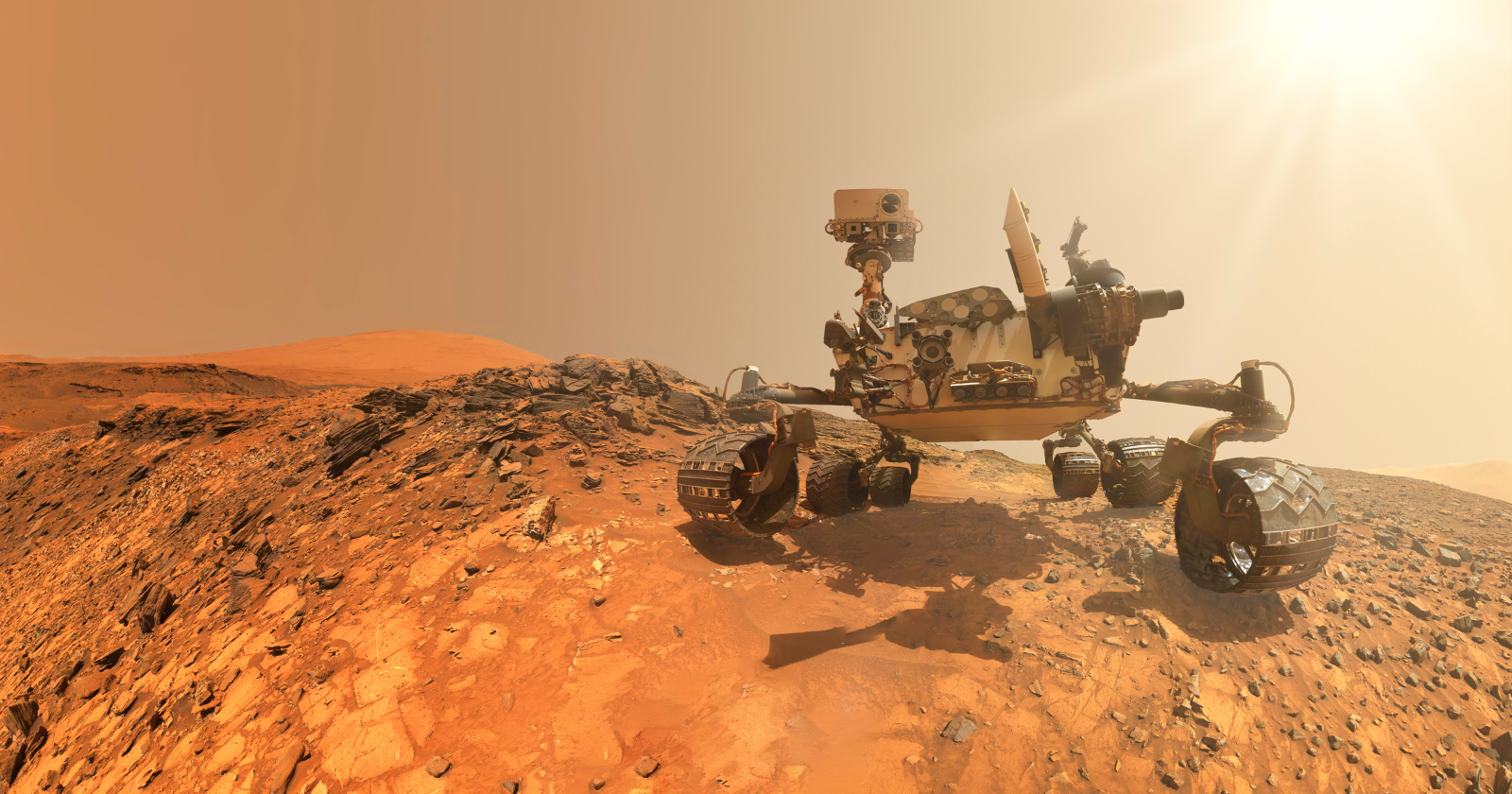
If you spend any time online, you’ve almost certainly encountered the story.
When NASA’s Opportunity rover died on Mars, the tale goes, its final transmission was heartbreakingly human. As a planet-wide dust storm blotted out the sun and its solar panels failed, the little rover sent one last message home: my battery is low and it’s getting dark.
People have wept over that line. They’ve shared it millions of times. Some have had it tattooed onto their bodies. It has become one of the most famous “quotes” in the history of space exploration.
There’s just one problem. Opportunity never sent it. No rover ever sent it. Those words were never transmitted from Mars at all.
What Opportunity actually did
The basic facts of the rover’s death are real, and genuinely moving.
Opportunity landed on Mars in January 2004 with a planned mission of 90 days. It lasted just under fifteen years — roughly 55 times its design life — rolling more than 28 miles across the surface and reshaping what scientists knew about the planet’s watery past.
In mid-2018, a dust storm grew until it wrapped the entire planet. Opportunity, which ran entirely on solar power, could no longer charge its batteries. On June 10, 2018, it sent its last transmission and fell silent.
But that transmission was not a sentence. It was not poetry. It was not, in any meaningful sense, “words” at all.
It was telemetry — a routine, technical data dump. Power readings. Atmospheric measurements. The same engineering data the rover had been sending for fourteen years. To the engineers receiving it, that data indicated the rover’s power was critically low and the sky was darkening with dust. But the rover did not say that. It transmitted numbers. The numbers meant that. The difference between those two things is the entire story.
Where the sentence actually came from
The famous line was written by a human being. On Earth. Months later.
In February 2019, as NASA prepared to formally end the mission, a science reporter named Jacob Margolis — then at the Los Angeles public radio station KPCC and its news site LAist — was writing about Opportunity’s death. He had spoken to NASA scientists about the rover’s final data, and he was trying to convey, for a general audience, what that data had meant.
So he wrote a tweet. He summed up the meaning of those last technical readings in plain, human language, saying the rover’s final message had, in essence, told NASA: my battery is low and it’s getting dark.
He was paraphrasing. He was translating dry telemetry into something a reader could feel — doing, in the most ordinary sense, the job of a science writer. He was not quoting the rover. There was no quote to give. The rover had no words.
But the sentence he wrote was so good — so simple, so quietly devastating — that it slipped its leash almost immediately.
How a paraphrase became a quote
Within days, Margolis’s sentence was everywhere. And as it spread, the context fell away.
The qualifying words — in essence, basically, translated to — got stripped off as the line was copied and recopied. The paraphrase hardened into a quote. “Here’s roughly what the data meant” became “here is what the rover said.” And then that became, in the retelling, the rover’s actual final words, transmitted from the surface of Mars.
Margolis watched this happen, and was, by his own account, somewhat alarmed by it. He later wrote a piece explaining what he had actually meant — that he had been paraphrasing, that the rover had not literally sent those words.
It didn’t matter. The myth was already too good, and too widely loved, to be pulled back. The clarification reached a fraction of the people the original sentence had. To this day, the line is shared, constantly, as the literal last words of a dying robot.
Why the true story is sadder, not less sad
Here is the strange part. Knowing the truth doesn’t drain the emotion from the story. It relocates it.
The myth is sad in a simple way: a brave little robot, alone, announcing its own death in heartbreaking language.
The truth is sad in a deeper way. The rover felt nothing, said nothing, announced nothing. It did not know it was dying. It did not experience the dark. It transmitted numbers until it couldn’t, and then it stopped. The poetry was never in the rover.
The poetry was in us.
The sentence exists because a human being looked at a machine that had worked faithfully for fourteen years, felt a genuine pang of grief at its silence, and reached for language to carry that grief. The line is real emotion — it’s just our emotion, not the rover’s. It’s the sound of people mourning a machine they had, against all reason, come to love.
That’s the genuinely moving thing here. Not that a robot spoke its last words, but that a robot’s quiet, wordless death moved people so deeply that they wrote it the words themselves. The Opportunity team did grieve — engineers who spent years on the mission have spoken openly about how hard the end was. NASA played Billie Holiday’s “I’ll Be Seeing You” during the final, unanswered recovery attempt.
The grief was always real. It just belonged to the people, not the machine.
What’s actually true
So here is the accurate version, for anyone who wants to keep the story without keeping the myth.
Opportunity outlived its mission 55 times over. It died in a global dust storm in June 2018. Its final transmission was ordinary engineering telemetry — no words, no message, no farewell. Months later, a science journalist named Jacob Margolis beautifully paraphrased what that data meant, and his paraphrase escaped into the world and became one of the most believed misquotes in modern history.
The rover never said it was getting dark. But a planet full of people, watching a small distant machine go silent forever, felt that it was — and needed a way to say so.
That’s not a quote from Mars. It’s something rarer. It’s the moment a piece of hardware became, in the minds of the people who built and loved it, something close to a friend.
