
Stephen Hawking died in March 2018.
In the eight years since, the world has done something genuinely strange. It has confirmed, item by item, almost every warning he spent his final decade trying to make people listen to. The climate accelerated past lines he was worried about. Artificial intelligence outpaced his most alarming predictions. The asteroid-detection programmes he supported found more candidates than expected. The geopolitical stability he assumed in the background of his warnings has visibly weakened.
And underneath all of it, his core argument is starting to look less like a physicist’s eccentric obsession and more like the most pragmatic warning of the last twenty years.
He believed humanity had to become a multi-planet species, and quickly. Not in five hundred years. Not in two hundred. Within the lifetime of people alive today.
In 2018, that sounded a bit much. In 2026, it sounds increasingly hard to argue with.
What he actually said
Hawking’s final years featured a series of escalating warnings, most of which got reported as if they were one warning. They weren’t. They were a coherent picture, assembled across several speeches and his posthumously published book Brief Answers to the Big Questions.
At the Royal Society in London in 2017, he said humanity had around 100 years to leave Earth or face extinction. Later that year, at the Tencent Web Summit in Beijing, he extended the window to about 600 years, citing energy consumption, population growth, and climate change turning Earth into “a giant ball of fire.” At the Starmus Festival in Norway, he said the threats had become “too big and too numerous” for him to be positive about the future.
What he was clear on, consistently: humanity could no longer afford to keep all its eggs in one basket. “In the long run the human race should not have all its eggs in one basket, or on one planet,” he said. “I just hope we can avoid dropping the basket until then.”
The specific number changed. The argument didn’t. Spread out into space, he said, or the laws of probability would eventually do to us what they had done to every other vulnerable species in earth’s history.
The threats he named
Hawking wasn’t being theatrical. He was naming specific, identifiable risks.
Climate change. Nuclear war. Pandemics. Genetically modified viruses. Asteroid impact. Artificial intelligence. He was particularly worried about what he called “low-probability, high-impact” events — the kind of risk that doesn’t show up in weekly news cycles but eventually arrives anyway.
He thought AI was the most immediate threat. In a 2017 speech in Lisbon, he said success in creating effective AI could be “the biggest event in the history of our civilization. Or the worst. We just don’t know.” In a Wired interview shortly before his death he said “the genie is out of the bottle. I fear that AI may replace humans altogether.”
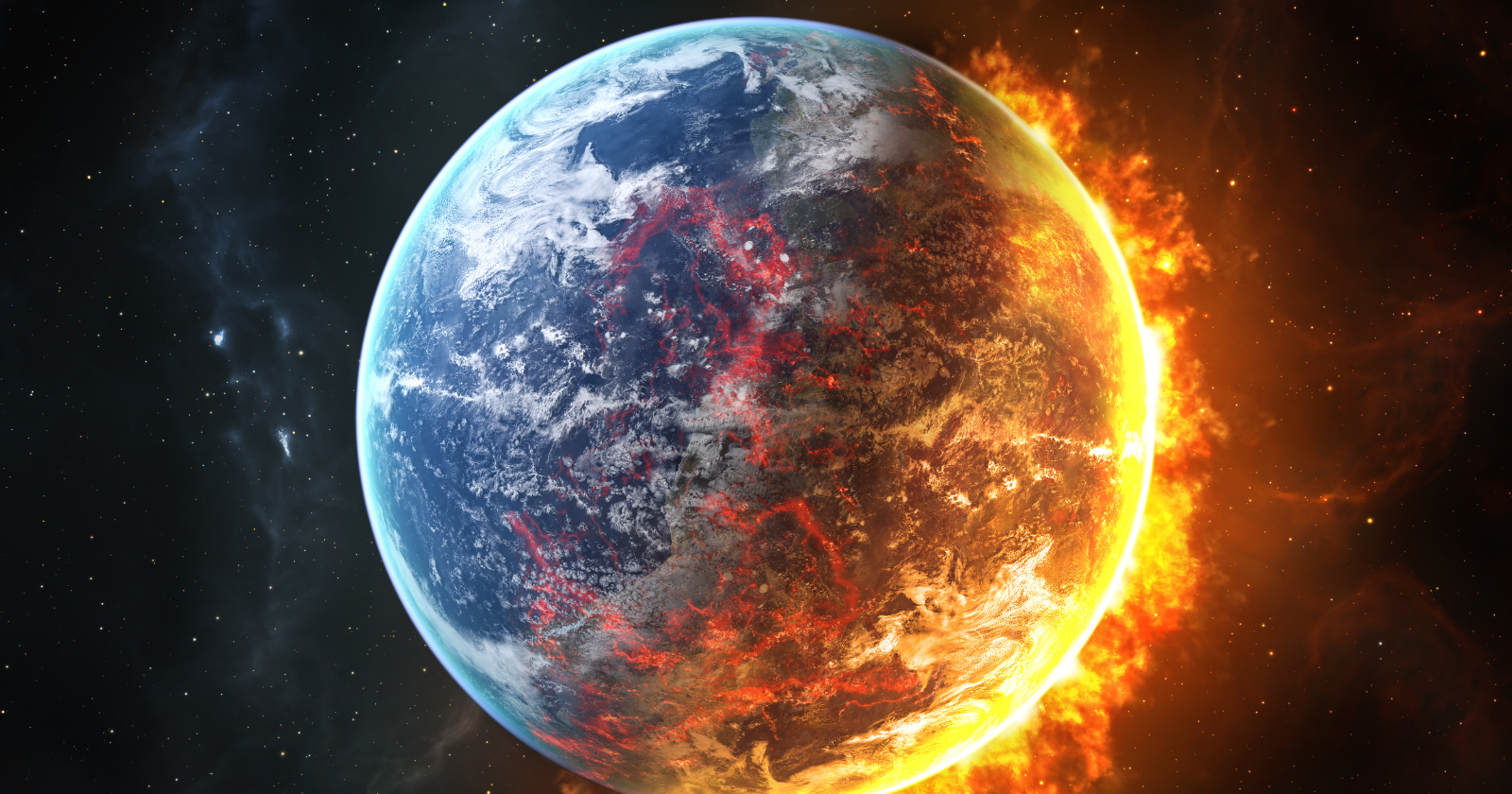
On climate, he warned in a 2017 BBC documentary that the planet was approaching an irreversible tipping point — that Earth could one day “look like Venus, with a temperature of two hundred and fifty degrees, and raining sulphuric acid.” He was widely mocked at the time for the comparison.
In retrospect, the mockery hasn’t aged well.
What’s actually happened since 2018
Look at the threats he named, one at a time.
On climate, 2024 became the first calendar year in human history in which the average global temperature exceeded 1.5°C above pre-industrial levels — the threshold the Paris Agreement was specifically designed to avoid. The ten warmest years ever recorded have all occurred in the past decade. Atmospheric CO2 reached 422 parts per million in 2024, a level Earth hasn’t seen in roughly three million years.
On AI, the 2026 International AI Safety Report, chaired by Turing Award winner Yoshua Bengio with input from more than 100 international experts, concluded plainly that AI capabilities are advancing faster than the safety measures designed to contain them. The International Institute for Management Development’s AI Safety Clock has moved from 29 minutes to midnight in September 2024 to 18 minutes to midnight by March 2026 — a faster acceleration than anyone forecasted when Hawking died.
On geopolitical stability, the assumption underlying most of Hawking’s warnings — that the major powers would continue cooperating on existential issues — has visibly weakened. Pandemic preparedness, which a brief moment in 2020 nearly transformed, has largely reverted. Biosecurity concerns about engineered pathogens are growing rather than shrinking.
On asteroids, the only one of his threats where things have got slightly better — NASA’s planetary defence programmes have improved significantly, and the 2022 DART mission successfully demonstrated that a spacecraft can deflect a small asteroid. So that one is genuinely better than he left it.
But the rest? Almost without exception, worse.
What the picture actually looks like now
Hawking was making a probability argument, not a prophecy.
He wasn’t claiming any one of these threats would definitely end us in a hundred years. He was claiming that you can’t simultaneously face increasing AI risk, an accelerating climate crisis, the constant background presence of nuclear weapons, the technical capability for engineered pandemics, and a planet on a single rock — and expect to make it through indefinitely.
The honest version of his argument, stripped of the headlines, was this. Take any one of these risks in isolation, and humanity probably survives. Stack them on top of each other, on a single planet, with no backup, indefinitely — and the probability that nothing catastrophic happens before we’ve spread out becomes smaller and smaller with each passing decade.
Eight years after he died, that math is harder to argue with, not easier. Every one of the variables he was watching has moved in the wrong direction.
Why the multi-planet argument is no longer fringe
When Hawking was making this case in 2017, the idea of becoming a multi-planet species sounded like a personal eccentricity of an aging physicist. Maybe Elon Musk wanted to go to Mars. Maybe a few science fiction writers. Almost nobody in serious policy circles was treating it as a real survival strategy.
That has shifted. Quietly. Underneath the headlines about rockets and billionaires, a much more sober version of Hawking’s argument has been taken up by a growing number of risk researchers, biosecurity experts, and AI safety advocates. The reasoning is now less about adventure and more about insurance.
If everything goes well, a multi-planet humanity is a luxury. If even one of the major risks plays out badly, it becomes the only reason our story continues.
Hawking saw this in 2017. Most people thought he was being dramatic. He was, by the look of things, just running the numbers one decade earlier than the rest of us.
What he’d probably say now
We can’t ask him. But the framework he left us is fairly clear.
He’d note that the trajectory of the last eight years has confirmed the broad shape of his argument. He’d probably argue, even more forcefully, that the time we have to become a genuine multi-planet species is shorter than people think — not because Mars is a paradise, but because Earth is increasingly the only basket holding all our eggs, and the basket is getting wobblier, not steadier.
He’d also note, characteristically, that there’s no point being fatalistic about any of it. “I just hope we can avoid dropping the basket until then,” he said.
Eight years on, the basket is still in our hands. The wobble, however, is harder to ignore.
That, in the end, is what Hawking spent his final years trying to tell anyone who would listen. Almost nobody really did at the time.
We are, slowly, starting to.
