
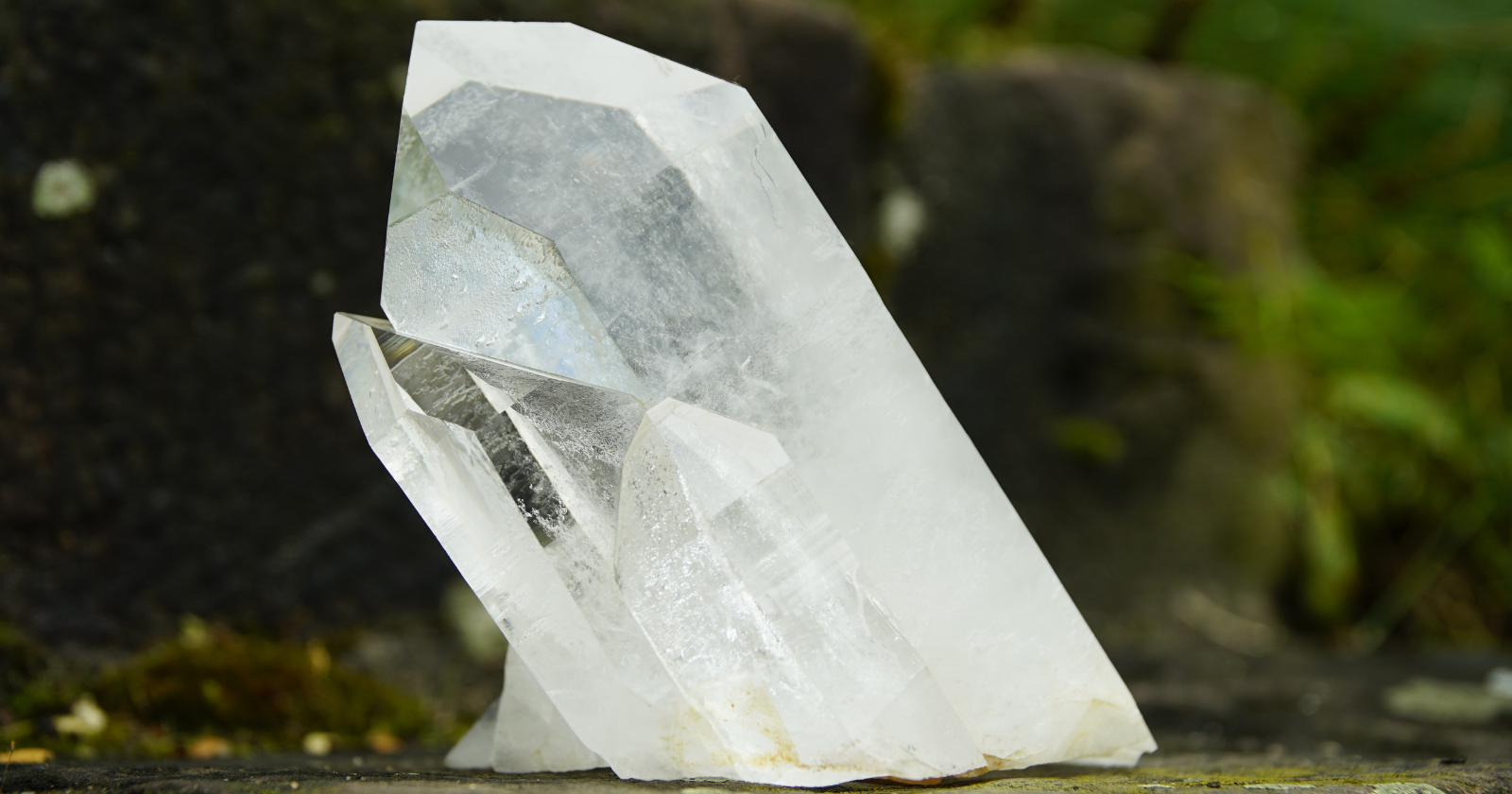
The device you are reading this on contains a silicon chip. That chip almost certainly began its existence as molten silicon, sitting in a bucket-shaped vessel called a crucible. And that crucible was almost certainly made from quartz dug out of the ground near Spruce Pine, North Carolina — population about 2,200.
It is one of the strangest chokepoints in the modern economy: the entire digital world funnels, at one invisible step, through a small Appalachian town most people have never heard of.
Why the chip needs the crucible
To make a chip, you start with silicon, and silicon starts as quartz — silicon dioxide, the most common stuff in ordinary sand. That part is abundant everywhere.
The problem is melting it cleanly. Refined polysilicon has to be melted and grown into a single flawless crystal — the ingot that gets sliced into wafers — and the melting happens inside a fused-quartz crucible that touches the molten silicon directly at blistering temperature.
Here purity becomes everything. If the crucible carries even trace contaminants — aluminum, sodium, iron, titanium, boron, lithium — those atoms leach out of the hot quartz and into the silicon, poisoning the crystal and ruining the chips. The crucible must be made of quartz so pure it will barely react with what it holds. Ordinary quartz, however clear it looks, is riddled with these impurities at the atomic level. Almost none of it is clean enough.
Why Spruce Pine
The quartz around Spruce Pine is clean enough, and the reason is a geological accident nearly 400 million years old.
When the landmasses that became Africa and North America collided to build the Appalachians, a pocket of molten rock cooled slowly, deep underground, under enormous heat and pressure — and, crucially, in the near-total absence of water. Water carries the impurities that normally seed into growing quartz. Without it, the crystals here grew extraordinarily pure. The result has been called the purest natural quartz ever found on Earth.
Nothing about this was planned, and nothing has replaced it. Two operations mine and refine the deposit — Sibelco, the Belgian minerals giant, and The Quartz Corp — turning out grades of quartz sand marketed under names like Iota, the finest of which runs to about 99.9992 percent silicon dioxide. Construction sand sells for a few dollars a ton; the purest Spruce Pine quartz has been valued around $10,000 a ton. By common estimates, 70 to 90 percent of the world’s high-purity quartz for crucibles comes from this one district.
The “only source” caveat, told straight
It is tempting — and much of the internet has given in to the temptation — to say Spruce Pine is the sole possible source, and that a disaster there would end the chip industry. The honest version is more careful.
Spruce Pine has a near-monopoly, not a total one. Other high-purity quartz operations exist — Russian Quartz in Russia, a Norwegian source, and Jiangsu Pacific Quartz in China, which recently cleared certification to supply some semiconductor equipment — but for the specific, punishingly clean quartz used to make the crucibles that grow the ingots, Spruce Pine remains the dominant, and for high volumes effectively the only, dependable supplier. Fully synthetic quartz can be manufactured, but it is more expensive and not produced at anything like the scale needed to replace the mines. So the dependency is real, even if “no alternative exists anywhere” overstates it.
And the fragility is not hypothetical. In 2008, a fire at one Spruce Pine plant briefly choked off much of the world’s high-purity quartz supply. In 2024, Hurricane Helene flooded the region and shut both mines for a time, and the tech press spent weeks openly worrying about the chip supply chain — precisely because so much runs through one valley with one set of roads.
The moral in the sand
The Spruce Pine story is a lesson in how invisible the foundations of modern life can be. Trillions of dollars of the global economy — every phone, every laptop, every data center, every guided missile and solar panel — rest on a material almost nobody thinks about, mined in commercial quantity in essentially one place, for a reason nobody engineered and no one can easily reproduce.
We tend to picture the chip industry as a story of human genius: the fabs, the lithography, the billion-dollar machines that etch features a few atoms wide. All of that is real. But underneath it sits a humbler fact, laid down 380 million years before the first transistor: the whole towering enterprise begins in a crucible, the crucible needs quartz cleaner than nature almost ever makes it, and nature happened to make it, once, under a town of 2,200 people in the mountains of North Carolina. The most advanced industry on Earth stands on a coincidence in the rock, and has not yet found a way off it.
