
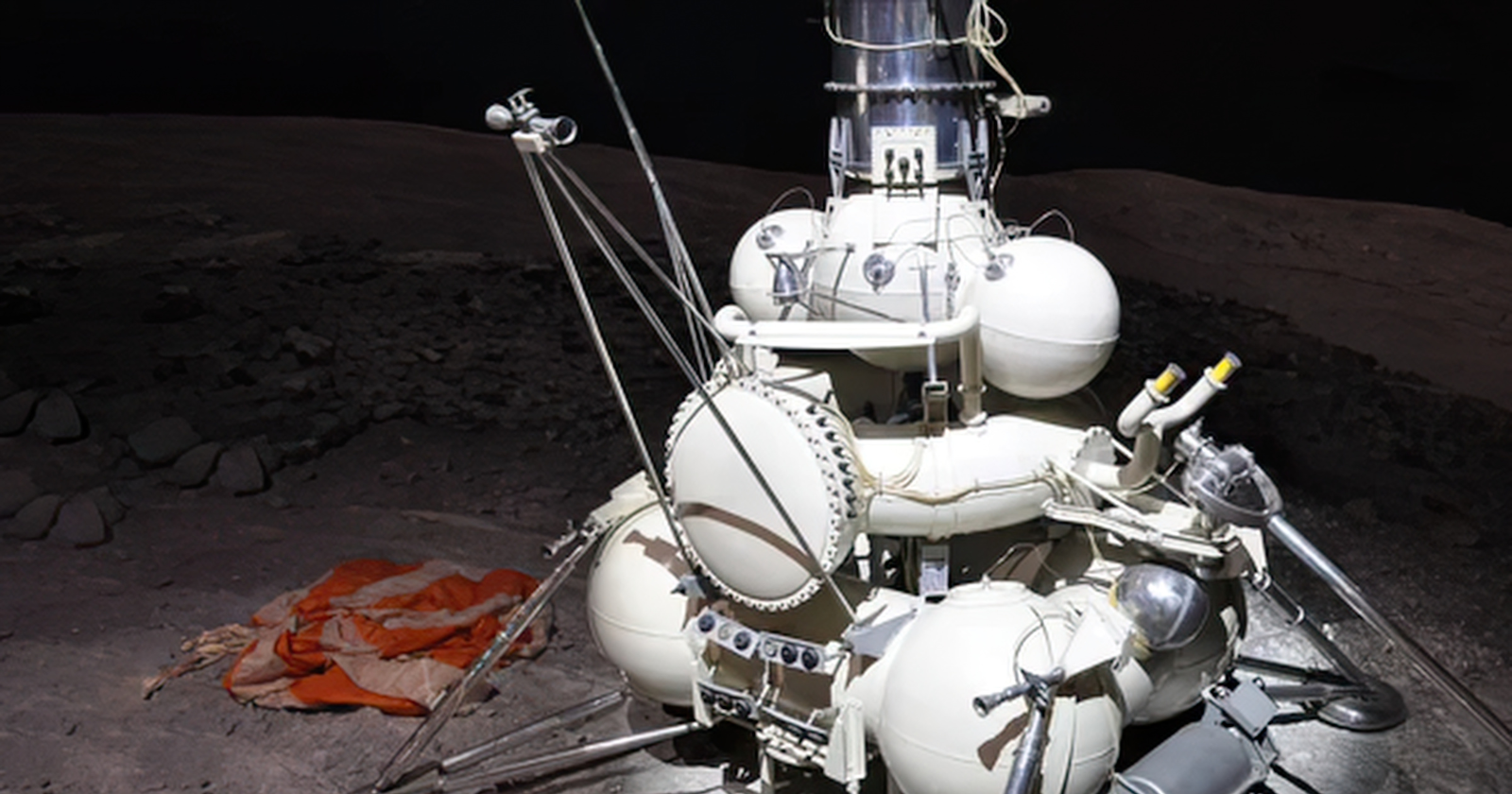
In April 1967, a robotic NASA lander called Surveyor 3 settled onto the Ocean of Storms, scooped at the lunar soil, sent home more than 6,000 photographs, and then went quiet as the two-week lunar night fell. It was never heard from again.
Two and a half years later, a spacecraft with two men aboard came down out of the black sky and landed close enough to walk to it.
The pinpoint landing
That closeness was the whole point of the mission. Four months earlier, Apollo 11 had made history but missed its target zone by about four miles. For Apollo 12, NASA wanted to prove it could put a crew down on a precise spot — the difference between “we reached the moon” and “we can land wherever the science is.”
They chose the hardest possible target: the exact patch of the Ocean of Storms where Surveyor 3 sat. On November 19, 1969, Commander Pete Conrad and Lunar Module Pilot Alan Bean brought the module Intrepid down and parked it, by NASA’s own measure, about 600 feet from the old probe — a bullseye across a quarter-million miles. Surveyor 3, as it happened, was resting on the inner slope of a small crater, and the astronauts had landed near its rim.
Two spacecraft, one photograph
On their second moonwalk, Conrad and Bean hiked down into the crater to the silent lander, becoming, in effect, the first space archaeologists — humans visiting a machine that had reached another world before them. It remains the only time it has ever happened.
They took “tourist” photos beside it, then documented it properly from every angle, and one image from that day is quietly astonishing: two American spacecraft sitting together on the surface of the moon, the dead robot in the foreground and Intrepid, the crew’s ride home, on the horizon behind it. Nobody had ever photographed two of humanity’s vehicles parked on another world, because there had never been two in the same place.
The men noticed something odd right away. Surveyor had left Earth gleaming white; now it looked tan, almost brown. Bean assumed the color had changed — until they rubbed it and found the truth underneath. It wasn’t discolored. It was filthy: coated in a fine film of lunar dust, much of it kicked up by Intrepid‘s own descent engine landing nearby. Under the grime the white paint was still bright.
Cutting off a piece of the moon’s history
Then came the job they’d trained for. Using cutters, Conrad removed pieces of Surveyor 3 to bring home — most importantly its television camera, along with its sampling scoop, lengths of cable and tubing, and other components: about 22 pounds of a machine that had been sitting in the vacuum for 31 months.
The reason was pure engineering curiosity. No one had ever recovered hardware after long exposure to the lunar environment, and here was a rare chance to find out what two and a half years of vacuum, radiation, micrometeorites and 200-below lunar nights actually do to a spacecraft. Back on Earth, at the Hughes and JPL labs, engineers took the camera apart piece by piece to see what had survived. The answer, mostly, was: everything. The camera had endured 31 months and dozens of brutal night-day cycles largely intact — invaluable data for designing everything that would fly afterward.
The stowaway that (probably) wasn’t
Here is where the story took a famous, and cautionary, turn. When scientists cultured samples from inside the returned camera, they found something alive: Streptococcus mitis, a common human mouth bacterium. The headline conclusion was electric — the microbes had apparently survived two and a half years on the moon, and NASA publicized it as evidence that life could endure the trip between worlds.
For decades it was told as fact. But later reviewers went back through the handling records and found the more likely explanation was mundane and embarrassing: the camera was likely contaminated after it got back to Earth. The organism probably never spent a day on the moon; it spent it in someone’s mouth in a Houston lab. The “life survives on the moon” story is now regarded as most likely a case of sloppy handling — a reminder of how easy it is to find exactly the astonishing result you were hoping for.
That deflation doesn’t diminish the rest. The core of the story is solid and strange: a dead space probe with a two-and-a-half-year head start, and a crewed mission aimed so precisely that two men could stroll over, take its picture, and cut off its camera. Surveyor 3’s camera is a piece of the only robotic spacecraft humans have ever visited on another world, left for 31 months, and then brought home by hand. It went up unmanned, waited alone through 32 lunar nights, and came back as luggage.
