
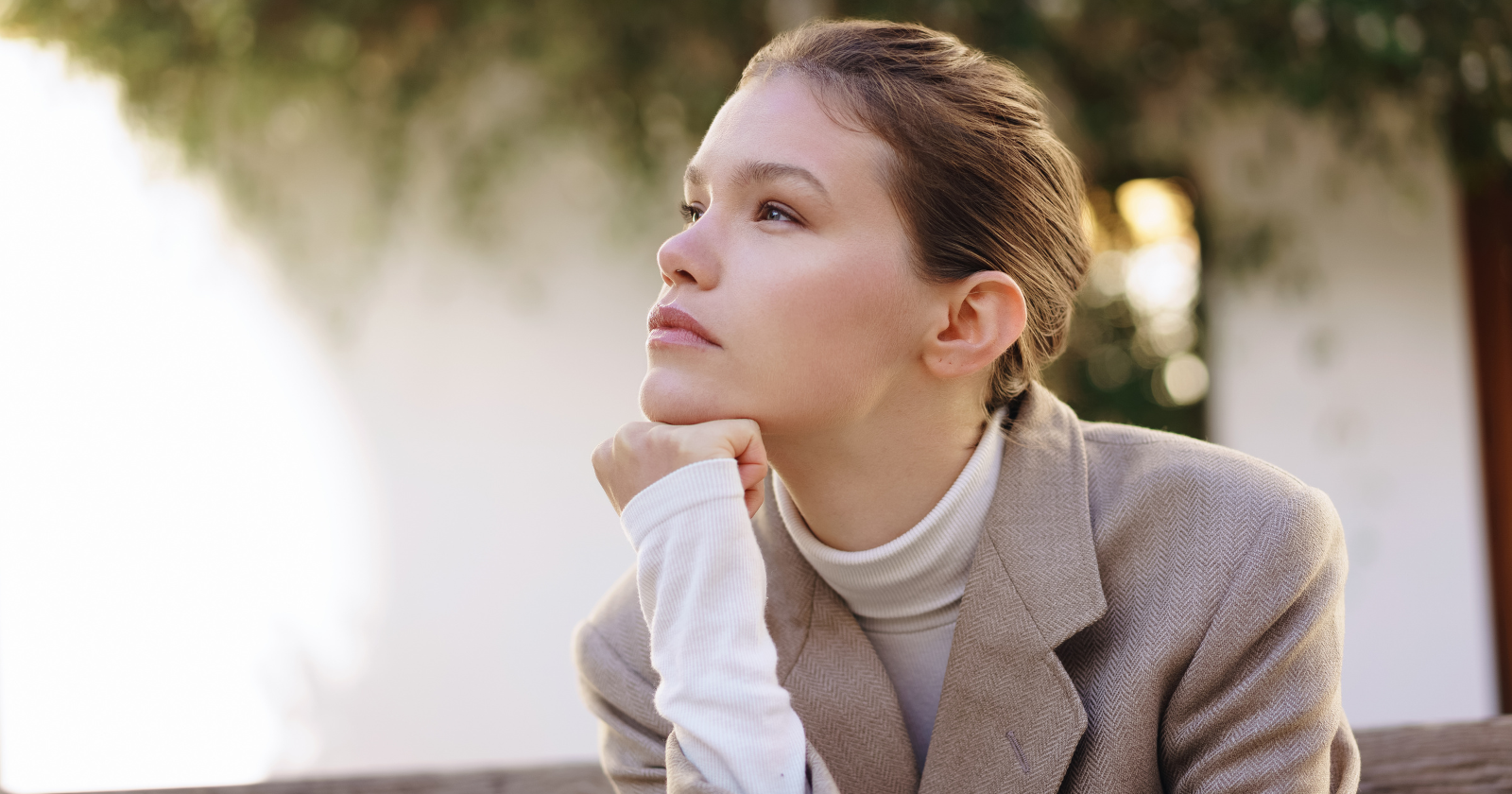
She was forty-seven when a friend asked her a simple question over dinner and she couldn’t answer it.
When was the last time you felt happy? Not content, not okay, not grateful. Happy. The kind of happy where you couldn’t have stopped it if you tried.
She sat there for what felt like a long time. She was good at this, normally. She was a list-maker. A reason-finder. If you’d asked her what she was grateful for, she could have given you twenty things in under a minute. Her health. Her marriage. Her kids. The roof. The job. The fact that she’d been born in a country where she could vote.
But the question hadn’t been about gratitude. It had been about happiness. The uncontrollable kind. And she sat across the table, scrolling backward through her own life, and slowly realized she couldn’t find one.
She didn’t cry. That came later, alone in the car. In the moment she just felt confused, the way you feel when you reach for a word you’ve used a thousand times and discover it isn’t there.
The sentence that did the damage
She’d grown up hearing it constantly. Whenever something hurt. Whenever something disappointed her. Whenever she was sad in a way her family didn’t have the bandwidth for.
Other people have it worse.
Sometimes it was about a child in another country. Sometimes it was about her grandmother during the war. Sometimes it was just a flat, weary delivery — other people have it worse, sweetheart, come on. The message was always the same. Whatever you’re feeling, it isn’t earned. Other people are entitled to feel this. You aren’t.
She wasn’t beaten. She wasn’t neglected in any obvious way. Her parents loved her. They were doing what they thought parents were supposed to do, which was to teach her perspective, to keep her from becoming spoiled, to make sure she didn’t grow up soft.
What they were actually doing, without realising it, was teaching her that her own emotional life was a kind of trespass. That to feel anything strongly was to be taking up space that rightfully belonged to someone with a more legitimate problem.
She learned the lesson well. She learned it so well that she stopped feeling things strongly at all.
What gratitude becomes when it’s a defense
Here’s the cruel part. The trait that this kind of childhood produces looks, from the outside, like a virtue.
These adults are grateful. Visibly, articulately, almost compulsively grateful. They thank everyone. They notice the good things. They keep gratitude journals. They are the people in your life who, when something nice happens, immediately tell you how lucky they are.
For a long time they look like they’ve cracked a code the rest of us are missing.
But there’s a difference between gratitude that arises and gratitude that polices. The first is a feeling. The second is a strategy.
When you’ve been trained, since you were small, to immediately translate every emotion into perspective, gratitude stops being an experience and becomes a kind of internal security guard. Don’t feel disappointed, you have so much. Don’t feel angry, others have real problems. Don’t feel sad, look at everything you’ve been given.
It works. It works really well. It keeps the difficult feelings off the property. The problem is that it doesn’t know how to let the good feelings in either, because it’s been trained to flatten everything in the name of perspective. The same mechanism that won’t let her feel hurt also won’t let her feel ecstatic. Both are too much. Both have to be smoothed.
So she ends up with a life that looks, on paper, abundant — and an interior that has been sanded down to a low, flat hum.
What uncontrollable happiness actually requires
Genuine, uncontrollable happiness — the kind her friend was asking about — requires something these adults were trained out of very early.
It requires the ability to fully receive a feeling without immediately doing something with it.
A child running through a sprinkler doesn’t pause to be grateful for the sprinkler. A friend laughing so hard at a joke that she can’t breathe isn’t comparing her laugh to the laughs of less fortunate people. A man kissed on a doorstep at twenty-three isn’t running an internal audit on whether he’s earned the kiss.
Happiness, the real kind, requires a moment of pure, unmediated reception. You feel it. You’re inside it. You don’t manage it. You don’t contextualise it. You don’t put it in perspective. You just have it.
That capacity is the first thing that gets killed when a child is taught that their own emotional life is a trespass. Because once you’ve internalised that lesson, every feeling has to pass through an audit before you’re allowed to fully feel it. Am I entitled to this. Is this proportionate. Is somebody, somewhere, having a worse day than I am.
By the time the audit is done, the feeling is already cold. You’ve turned a sprinkler into a spreadsheet.
The grief these adults eventually have to face
When this realisation lands — usually somewhere in the forties or fifties, often in a quiet conversation, sometimes alone in a kitchen — there is a particular kind of grief that comes with it.
It isn’t the grief of having been mistreated. Most of these adults will tell you, accurately, that their parents were doing their best. That nothing terrible happened to them. That they had food and shelter and people who loved them in their own way.
It’s a stranger grief than that. It’s the grief of realising that you have lived four or five decades inside a self that was never quite allowed to be there. That the small girl who would have laughed too loudly, cried too easily, wanted things too openly, was put in a quiet room a long time ago and the door has been closed ever since.
It’s the grief of being a tourist in your own emotional life.
And it’s complicated by the fact that you can’t be angry at anyone in the usual way. Your parents weren’t villains. They handed you a sentence they themselves had been handed. The damage was inherited, not invented.
The grief has to find a different shape. Not blame. Just acknowledgement. This happened. It cost me something. The cost was real.
The slow, awkward work of un-learning it
The good news, and there is good news, is that the capacity for happiness is not destroyed. It’s defended against. There’s a difference.
A capacity that’s been defended against for fifty years can be re-opened. It’s slow. It’s awkward. It feels, at first, embarrassing — like you’re being asked to use a muscle in front of people while you’re still learning how it works.
It looks like letting yourself want something small without immediately listing the reasons you shouldn’t want it. It looks like staying inside a good feeling for an extra ten seconds before the audit kicks in. It looks like noticing, when the gratitude reflex fires, that it’s a reflex — and gently asking it to wait while the actual feeling arrives.
It looks like being willing, occasionally, to say that hurt without adding but other people have it worse. Just that hurt. Full sentence. Full stop.
Because the strange thing about feelings is that they only stay alive when they’re allowed in both directions. The same door that lets the hard ones out is the door that lets the joyful ones in. Close it against one and you’ve closed it against the other.
What the small girl actually needed to hear
Somewhere in this process, almost everyone who does this work has the same private moment. They imagine the small version of themselves, the one being told that other people had it worse, and they think about what she actually needed to hear.
She didn’t need a comparison. She didn’t need to be reminded of someone else’s suffering. She didn’t need to be made into a more grateful, more grounded, more appropriately responsive child.
She needed someone to look at her and say, yes. That hurt. I see that it hurt. You’re allowed to feel it. The fact that other people are also hurting somewhere does not make your hurt less real.
That’s the sentence she should have been handed. That’s the sentence she’s been waiting fifty years to receive.
And here is the quiet, slightly miraculous thing. She can hand it to herself now. It will feel strange. It will feel, at first, like trespass. But it isn’t.
It’s the door finally being opened in both directions, after all these years of being held shut from the inside by a hand she didn’t realise was her own.
