
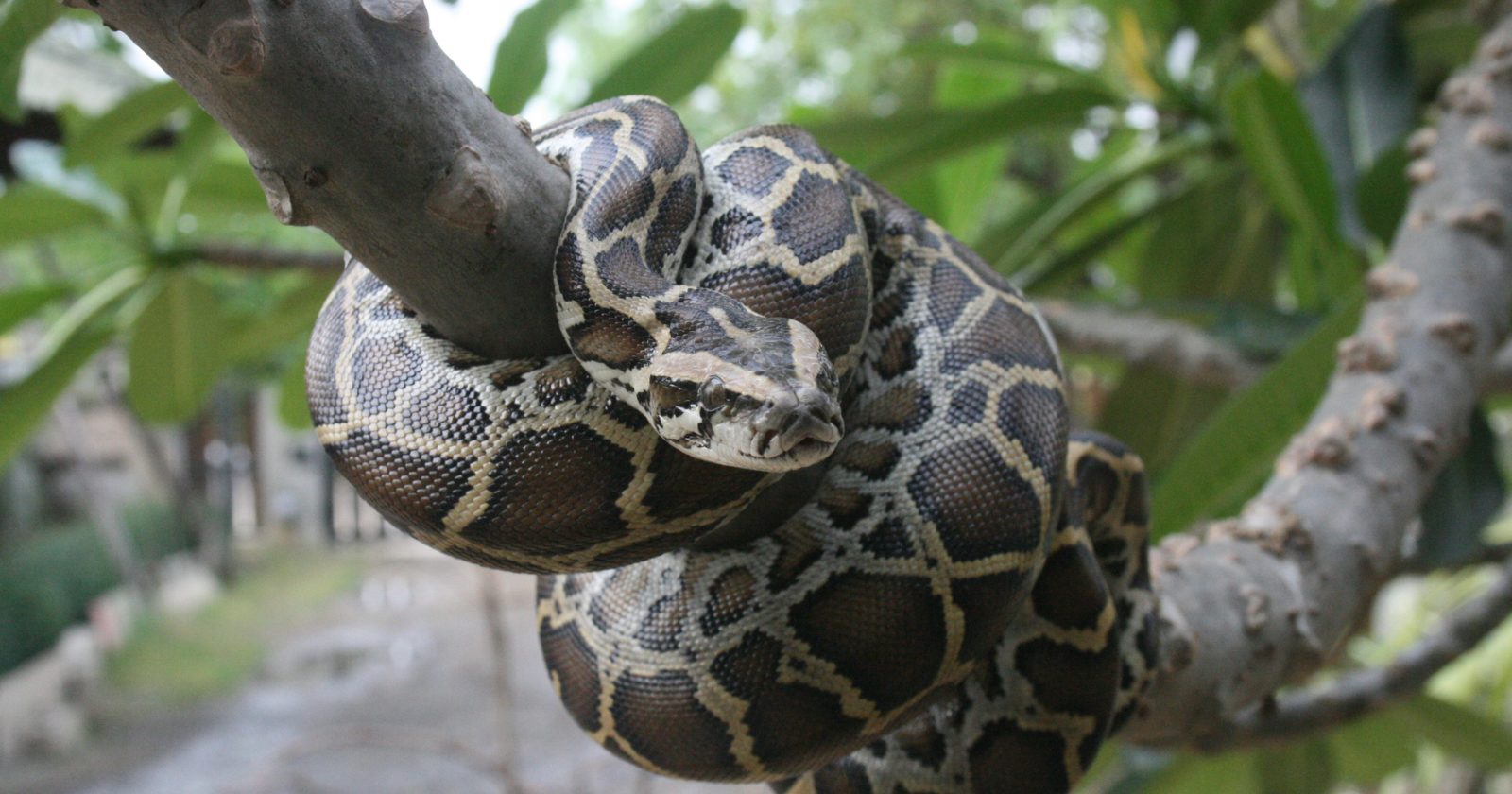
The Burmese python is the Everglades’ most notorious wrecking ball. Released or escaped from the exotic-pet trade decades ago, the giant constrictors have hollowed out South Florida’s mammal populations with brutal efficiency — in the worst-hit areas, raccoons, opossums, marsh rabbits and bobcats have crashed by more than 90 percent, eaten off the landscape by a predator the ecosystem never evolved to handle.
Which makes the newest finding about them genuinely strange. The snakes are not just eating the animals that spread the Everglades’ plants. They have quietly inherited the job.
Seeds in the snake
The discovery came out of python guts. For years, the Conservancy of Southwest Florida’s python team — the field crews who catch and dissect the snakes as part of ongoing removal — has been saving stomach and digestive-tract contents. Researchers led by Adrian Figueroa, with the University of Florida and the U.S. Geological Survey, went through those samples looking for something nobody had thought to check: plants.
They found 25 different seed types inside the pythons, published in the Journal of Zoology in 2025 — including native Everglades species like cabbage palm and creeping cucumber, alongside invasive ones. A snake does not eat fruit. So how does a carnivore end up full of seeds?
The answer is a mouthful of a word: diploendozoochory — secondary seed dispersal. A rabbit or a bird eats fruit and swallows the seeds. The python eats the rabbit or the bird. The seeds, already built to survive one animal’s digestion, ride along inside a second animal — the predator — and get carried wherever the snake goes before they pass out the far end, potentially far from where the first animal fed. The seeds hitchhike through the food chain by riding the thing that ate the hitchhiker.
The job that lost its workers
Here is why the finding matters beyond novelty, and why it circles back on the python itself.
Ecosystems depend on animals to move seeds around — mammals and birds eat fruit and deposit the seeds elsewhere, and that constant reshuffling is how plants colonize new ground and keep their populations mixed. In the Everglades, the pythons have been busy destroying exactly those animals: the mammalian seed-spreaders are the same raccoons, rabbits and rodents the snakes have eaten into collapse. The python knocked out the wetland’s seed-dispersal workforce.
And then, by eating them, absorbed a piece of their function. The predator that removed the seed-dispersing mammals is now doing a rough version of their old job itself — a single species that both fired the workers and inherited the work. It is not a replacement in any healthy sense; it is one animal accidentally occupying an ecological role it emptied.
The dispersal is not merely theoretical, either. A germination test on cabbage palm seeds run through a python’s gut found nearly 40 percent still sprouted afterward — proof the seeds survive the ride intact and viable, not just present. The snakes are moving live seeds, not dead ones.
Double agents
The obvious question is whether this is, in some small way, good news — an invasive monster accidentally doing a bit of conservation. The researchers are firm that it is not, and the honesty is the point.
The seeds cut both ways: the pythons carry native species conservationists would like to see spread, but also invasive plants that damage the same ecosystem — moving both, indiscriminately, into new and sensitive ground. The team’s own framing calls the reptiles “double agents,” and Figueroa is blunt that the ledger stays deeply negative: whatever incidental seed-spreading the snakes provide is dwarfed by the wreckage they cause, and nobody should read this as a reason to ease off python control. Surprisingly, the study found the pythons and their fellow invader, the Argentine tegu, actually carried more native seed types than invasive ones — but that statistic is a curiosity, not a defense.
The real value of the finding is subtler, and it is a caution against simple stories. We like our invasive species purely villainous and our ecological roles cleanly assigned, but a large predator dropped into a novel ecosystem does not read the job descriptions. It eats what it can, and in doing so it rewires the web in ways that are neither all destruction nor any kind of repair, but simply tangled — a snake that empties the wetland of its seed-carriers and then, bulging with the seeds those carriers swallowed, slides off across the sawgrass to plant them somewhere new. The Everglades did not ask for this gardener. It got one anyway, wearing the skins of the gardeners it replaced.
