
On the coldest mornings of a Florida winter, the water beside the Cape Canaveral Clean Energy Center turns lumpy. Hundreds of grey backs break the surface of the discharge canal at once, packed flank to flank in the plume where the natural-gas plant returns its cooling water to the Indian River Lagoon, a few degrees warmer than it took it in. Aerial survey photographs of the site look less like wildlife imagery than like traffic.
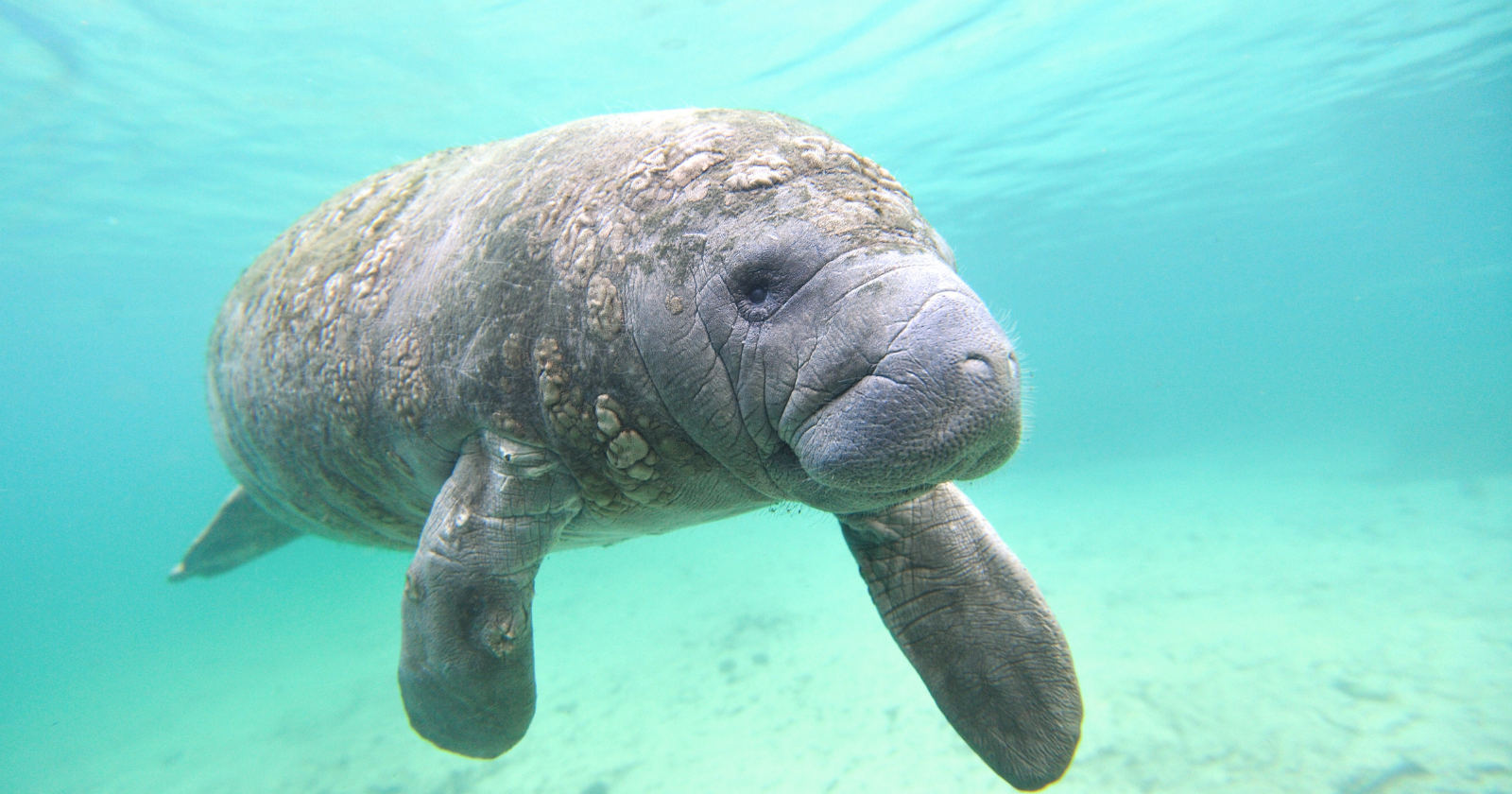
The animals are Florida manatees, and they are not visiting. By the account of Florida Power & Light, which runs the plant, the Canaveral discharge shelters as many as 1,000 manatees in a cold snap, one of the largest gatherings of the species anywhere, and on the coldest survey days roughly half of all the manatees counted in Florida are found not at springs or in mangroves but at power plant outfalls.
A tropical animal at the edge of its map
The manatee’s problem is a body built for the tropics wearing the wrong insulation. Despite the blubbery look, a manatee is mostly gut, not fat, and its metabolism runs remarkably slow for a mammal its size. Florida sits at the cold northern edge of the species’ range, and when water temperatures fall below about 68 degrees Fahrenheit, manatees become vulnerable to cold stress, a slow-motion syndrome of suppressed immunity, skin lesions, and organ failure that kills them not in hours but over days and weeks of exposure. A Florida cold front is, for a manatee, a medical emergency measured in degrees.
Evolution’s answer was migration to warm refuges: the artesian springs, like Blue Spring and Crystal River, that pour out groundwater at a constant 72 degrees all winter. But springs are few, many were degraded or blocked over the twentieth century, and they cluster in particular corners of the state. On the Atlantic coast especially, the manatee’s map of natural winter shelter was always thin.
The accidental spring
Then, mid-century, the power industry unintentionally built new springs. Coastal plants of that era used once-through cooling, drawing in seawater, running it past the condensers, and discharging it warmer, and a steady plume of warm water in a Florida winter is indistinguishable, to a manatee, from a spring that never runs dry. The animals found the outfalls within years of the plants opening, mothers taught the routes to their calves, calves grew up and taught their own, and within a few generations entire subpopulations had rewired their ancient migrations around industrial infrastructure. Statewide analyses of winter counts have found nearly half of all manatees wintering at power plant discharges, with the Atlantic coast subpopulation, the largest, leaning on them hardest.
The Canaveral plant is the flagship of the phenomenon. When FPL demolished the old oil-fired plant and opened its modernized gas-fired successor in 2013, the rebuild was engineered around its uninvited tenants, preserving the warm discharge and adding manatee protections, because by then the animals were not a curiosity but a dependency: a wildlife refuge with turbines attached, subject to federal protection plans that require the company to keep the warm water flowing in winter, cold front or breakdown notwithstanding. The state has gone further, imposing winter no-entry zones for boats around the discharge, and in the starvation crisis of 2021 and 2022, when seagrass collapse in the lagoon left the wintering herd hungry as well as cold, the plant’s discharge became the site of an unprecedented emergency operation: wildlife officers hand-feeding tons of lettuce to wild manatees massed in the warm water.
The trap inside the refuge
Biologists are grateful for the outfalls and deeply uneasy about them, because a refuge that depends on a power market is a refuge with an expiry date. The animals’ loyalty to their winter sites is nearly absolute; when plants have shut down in the past, manatees returned to the cooled discharge anyway and some died there, waiting for warmth that no longer came. This February the risk stopped being theoretical: dozens of manatee carcasses were pulled from the Orange River beside FPL’s Fort Myers plant after the discharge faltered during a cold snap, deaths the state is investigating as suspected cold stress at the very refuge the animals had staked their winter on.
That is the double edge folded into the spectacle at Canaveral. Florida’s energy system is drifting away from the coastal steam plants that made the warm water, and the state’s manatee planners now spend their careers on the question of how to wean a species off its industrial springs, restoring natural ones before the plugs are pulled. The hundreds of backs in the Canaveral canal are a conservation success, a rescue, and a hostage situation at once: a tropical mammal that survived Florida’s winters by adopting a machine, thriving in the one warm pool it cannot afford to have switched off.
