
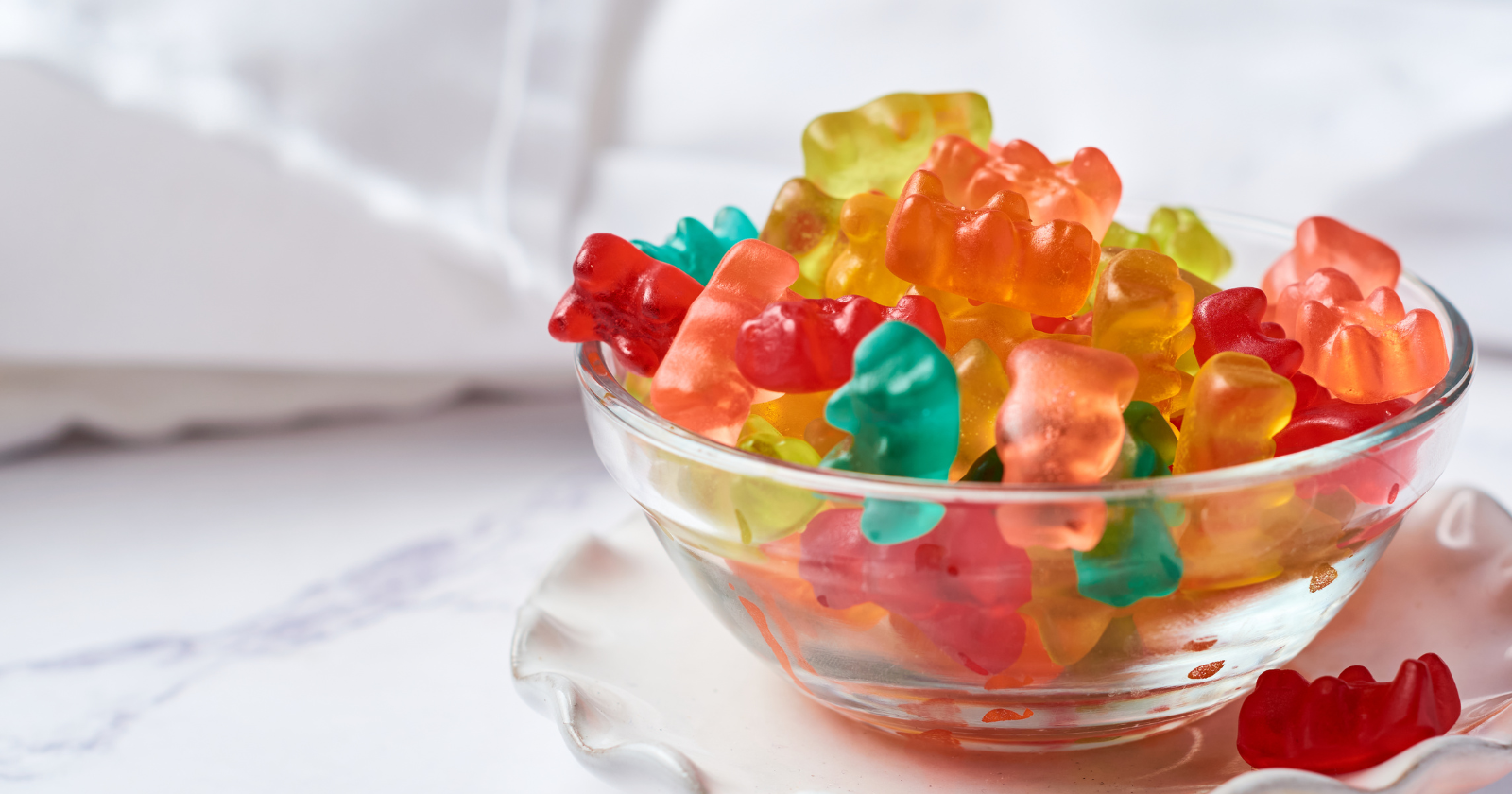
The sentence that carried the discovery around the world came from a chemical engineer named John Dorgan: “We recovered food-grade potassium lactate and used it to make gummy bear candies, which I ate.”
He was talking about a wind turbine.
Dorgan, a professor of chemical engineering and materials science at Michigan State University, presented the work at the American Chemical Society’s national meeting in 2022, and the gummy-bear line did what it was designed to do — but the candy is a demonstration, not the point. The point is a problem quietly piling up at the far end of the clean-energy boom.
The blade that won’t die
A modern wind turbine blade is a marvel with a terrible afterlife. Typically around 170 feet long — the length of an Olympic swimming pool — each blade must be light enough to spin and strong enough to survive decades of storms, which is why they’re built from glass fibre bound in tough thermoset resin.
That construction is the curse. Thermoset resins cure permanently; they cannot be melted down and reformed, so a decommissioned blade is a 170-foot object that resists almost every form of recycling. Blades come down after about 20 years, and tens of thousands are reaching that age. Some get sawn into sections and landfilled; some are ground up for cement; a scattering have been repurposed, genuinely, into bike shelters and playground structures in Europe. But the default fate of the thing that generated clean power for two decades is a trench.
Dorgan’s team went after the resin itself — the binder that makes blades un-recyclable — and redesigned it from the end backward.
Designed to be dissolved
The new material is a thermoplastic resin blended from glass fibres, a plant-derived polymer and a synthetic one. In panel form it tested strong and stiff enough to do a blade’s structural job, or a car window’s.
The difference is what happens at end of life. Where a conventional blade is a chemical dead end, this resin is designed to come apart. Dissolve it and the glass fibres release clean, ready for reuse; the freed polymer can be recast straight into another turbine blade, closing the loop the industry has never had — a blade that becomes a blade again, indefinitely. “It can be used over and over again in an infinite loop,” Dorgan said. “That’s the goal of the circular economy.”
Then the chemistry gets show-offy. Digest the same resin in an alkaline solution and it yields poly(methyl methacrylate) — plexiglass, the shatter-proof acrylic used in car taillights and windows. Push the reaction hotter and it produces poly(methacrylic acid), the superabsorbent polymer inside disposable diapers. The team even cast the recovered material into cultured stone and built a working bathroom sink from it.
And with one more step, the resin gives up food-grade potassium lactate — a common preservative and flavour agent in candy and sports drinks. Which is where the gummy bears came from, and where Dorgan made his point with his own mouth.
Carbon doesn’t care where it’s been
The gummy-bear stunt encodes a genuinely radical idea, and Dorgan stated it plainly: a carbon atom from a plant is identical to a carbon atom from a fossil fuel — it’s all one carbon cycle, and his team had shown you could run biomass from a field into a durable turbine blade and back into food.
That is the conceptual leap under the candy. We tend to sort matter by its current job — this is a turbine, that is a snack — but at the molecular level a well-designed polymer is just a temporary arrangement of atoms that can be reassigned. Build the material so its bonds can be undone on command, and a blade stops being a permanent object and becomes a bank of atoms on loan, due back as whatever is needed next.
The honest limits are real and the researchers name them. There isn’t remotely enough of this bio-based resin manufactured today to build turbines at industrial scale; the economics only work if a recycled blade becomes something worth more than landfill; and — Dorgan cheerfully conceded — the public may need convincing before it knowingly eats a turbine. Nobody is proposing to feed the grid to children. The gummy bear is proof of concept, not a snack strategy.
But as proof of concept it is almost perfect, because it collapses the whole waste problem into one image. The complaint against wind power’s blades has always been that they end as buried junk, a dirty secret at the bottom of a clean industry. Dorgan’s answer was to engineer a blade that could end, instead, as a windshield, a diaper, a countertop, another blade — or, to prove there was no floor to how thoroughly it came apart, as a handful of candy eaten by the man who designed it. The blade that used to become garbage can now, in principle, become anything. He just picked the most disarming thing on the list.
