
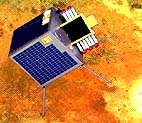
Just three months after its launch, the Cooperative Research Centre for Satellite Systems’ FedSat scientific and engineering satellite is supplying a wealth of information to Australian and international researchers.
“All of the experiments on board are functioning well and the amount of valuable data from the satellite grows daily,” said Executive Director Dr Brian Embleton.
Highlights of the satellites performance to date include:
Operation of the NewMag magnetometer, which measures electric currents in the ionosphere above the Earth. The instrument in being used to gather information on the impact of charged particles from the sun upon the “space weather” which can disrupt communications and affect power grids on Earth.
Initially, the device is being used in conjunction with ground-based instruments in the Polar Regions, as part of an international research program involving scientists from Japan, Australia, the USA and other countries.
Commencement of experiments aimed at developing new types of computers for use in space. FedSat’s “High Performance Computer” uses re-configurable logic which enables operators in the ground to make changes to the on-board hardware.
This feature could be exploited in new-generation satellite computers which can be effectively “repaired” by ground command after being damaged by the effects of radiation.
FedSat’s Global Positioning System receiver is supplying navigation information to help in tracking the satellite. Centre researchers use the past position data, in a mathematical model, to accurately predict the satellite’s future position.
Data from the receiver are also used to probe the electron content of the Earth’s upper atmosphere, an important factor for determining the efficiency of communication systems that rely on reflections from the ionosphere.
FedSat’s primary ground station in Adelaide is communicating with the satellite every week day and most weekends. The innovative fast-tracking Ka band ground station in Sydney was opened in late February. Together, the ground stations have proven the successful operations of the complex, multi-band communications system on board.
The satellite’s Star Camera has been brought into regular use to accurately determine the orientation of the satellite. This step increases the scientific value of the data obtained from the magnetometer.
“The commissioning stage of testing the performance of a new satellite often lasts many months, especially when the satellite is the first one an organisation has built.
“FedSat is probably more complicated than any other satellite of its size, but we have managed to orient it correctly, we have extended the 2.5 metre boom holding the magnetometer space science instrument, and we have progressively brought each payload into operation, all in a relatively short time,” said Satellite Program Manager Mirek Vesely.
“We have found that the power system is better than we had expected, so we are able to run the experiments for longer than we had planned.”
The satellite ¿ the first built in Australia in more than thirty years ¿ carries scientific instruments and engineering test equipment.
The Cooperative Research Centre for Satellite Systems, which carried out the project, intends to use information from the satellite to carry out research and development in space science, navigation, satellite computer systems, and communications.
The Centre currently employs fifty-one staff, and about forty post-graduate students are engaged in the Centre’s education program.
FedSat was one of four satellites successfully launched from Tanegashima Space Centre on 14 December by the fourth flight of Japan’s H-IIA rocket. It was the first foreign satellite launched by this vehicle.
Under a special arrangement between the CRCSS and the National Space Development Agency of Japan (NASDA), the launch service was supplied in exchange for scientific data from the satellite. Late last month over ten researchers from NASDA joined their Australian colleagues in Adelaide to study the first scientific results from the satellite’s three-year mission.
