
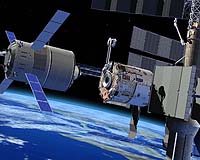
An essential communications system to enable successful docking of Europe’s Automated Transfer Vehicle (ATV) and the International Space Station (ISS) was today launched on board the ‘Progress’ cargo delivery vehicle by Soyuz flight 352.
The PCE (Proximity Communication Equipment) was developed and integrated in Toulouse by EADS Astrium, as part of the European Space Agency’s ATV programme, for which EADS SPACE Transportation is prime contractor.
The PCE will enable proximity communications for the last 30km of flight of the future European ATV cargo vehicle on its approach to the ISS. This system will be the first component element of the ATV system to be placed in orbit. Tests are scheduled for early April 2005, and the success of these tests will pave the way for the “Jules Verne” ATV launch.
The PCE is an integrated sub-assembly providing two, fully redundant S-band communication chains. It comprises two spread spectrum transponders and two CCSDS protocol management modules plus associated microwave equipment.
Installed in the Zvezda module on the ISS, the PCE system will be operated during the “proximity” phase corresponding to the last 30km of the ATV’s flight, and the delicate docking operation with the ISS. This automatic in-orbit rendezvous will be a European first.
The command and control data transmitted by the PCE as part of its communications mission, will include GPS positioning data required for relative navigation of the ATV towards the ISS.
At a distance of 500m from the station up to actual docking, ATV navigation will be controlled by laser instruments, initially a telegoniometer, followed by a videometer for the final phases.
Electrical tests on the PCE, which were performed by a combined ESA, Industry and Russian team, were completed successfully at the Russian base of Baikonur in Kazakhstan, in early February 2005. The complete PCE assembly will be checked out on the space station in early April 2005.
The ATV is the most challenging and complex space vehicle ever to be developed and built in Europe. Currently, the prototype ATV Jules Verne is at the ESTEC facility in Norwijk, Holland, undergoing further integration and testing under the responsibility of EADS SPACE Transportation.
The compatability testing programme includes electromagnetic environment, accoustic, thermal, and vacuum tests as well as mechanical testing. At the beginning of 2005, the cargo carrier was inspected by astronauts.
The ATV Jules Verne is due to be shipped to Kourou in French Guiana in November this year where it will undergo final testing (including fuelling) ahead of integration with the Ariane 5 rocket prior to launch.
