

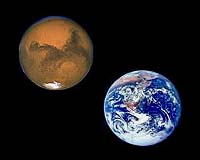
“Despite differences in the chemical compositions and densities of Earth’s and Mars’ atmospheres, we now have a definitive example showing that both planets’ atmospheres react similarly to varying levels of solar energy impacting them during the sun’s 25-day rotation,” says Elsayed Talaat, a space scientist with the Johns Hopkins University Applied Physics Laboratory (APL) in Laurel, Md.
Talaat’s findings, which will be presented in an AGU session (Comparative Planetology: Atmospheres and Aeronomy I) on May 26 at 11:25 a.m., could help the atmospheric science community better understand the relationship between the sun and its effects on planetary atmospheres.
Comparing limited ionospheric data sets acquired in 2003 by NASA’s Mars Global Surveyor (MGS) and the agency’s TIMED SEE instrument (Solar Extreme Ultraviolet Experiment), Talaat says his findings provide evidence that the photochemistry of Mars’ ionosphere responds similarly as Earth’s to solar inputs.
“The upper atmospheres of both planets are impacted by varying levels of high-energy solar X-rays and extreme ultraviolet radiation during the sun’s rotation – the same type of data collected by the SEE instrument,” Talaat says. “I looked at the variation in solar irradiance found in SEE’s data and correlated that with the variability in Mars’ ionosphere.”
To compensate for the sun’s different rotational time periods as would be perceived from Earth and Mars, he shifted SEE’s data to match the Mars timeframe. When two charts depicting the Mars peak ion density and solar activity levels during a common timeframe were overlaid, the plots aligned.
The Mars ionospheric profiles were retrieved from the radio transmissions from NASA’s MGS Radio Science Experiment led by Dr. David Hinson of Stanford University.
