
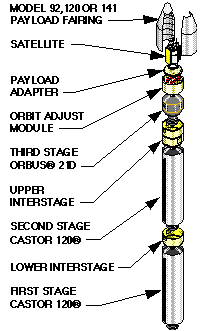
ATK (Alliant Techsystems) said a solid rocket motor developed and produced by ATK Thiokol Propulsion Company, Promontory, Utah, helped launch an Athena I space launch vehicle on its first mission from the new Kodiak Launch Complex in Alaska on Sept. 29.
The CASTOR 120 motor provided the first-stage thrust to the Athena I vehicle during the first 85 seconds of the mission, which placed four individual satellites into two different orbits for the National Aeronautics and Space Administration (NASA) and the Department of Defense Space Test program. The satellites will perform research and educational missions.
Lockheed Martin Space Systems Company, Denver, Colo., builds the Athena I vehicle, which is capable of boosting payloads of up to 1,750 pounds.
Designed and developed by ATK Thiokol Propulsion Company as a company-funded effort, the CASTOR 120 motor serves as the basic building block for the U.S. ground-based small launch vehicle fleet. It provides boost propulsion for not only the Athena family of vehicles but also for the Orbital Sciences Corporation Taurus rocket.
The CASTOR 120 motor weighs approximately 116,000 pounds, with propellant accounting for approximately 107,000 pounds of the total weight. The company’s TCR resin formulation is used in the motor’s case material.
Among the four satellites placed into orbit by the Athena I was the Starshine 3 satellite developed by the Rocky Mountain NASA Space Grant Consortium and built by the Naval Research Laboratory. ATK Thiokol Propulsion Company is a member of the Rocky Mountain Consortium, which is headed by the Space Dynamics Laboratory at Utah State University, Logan, Utah.
