
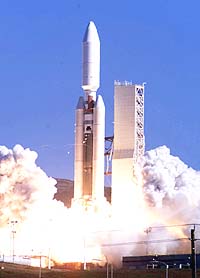
Alliant Techsystems (ATK) said rocket motors designed and manufactured by its Aerospace Group helped launch a Lockheed Martin Titan IV B rocket carrying a National Reconnaissance Office (NRO) satellite from Vandenberg Air Force Base, Calif. on Oct. 5. The launch marks the 11th flight of the Titan IV B rocket.
Two Solid Rocket Motor Upgrade (SRMU) motors, each measuring 112 feet long and 10.5 feet in diameter provided the zero-stage boost assist for the Titan IV B during its initial 148 seconds of flight. Twenty-two SRMU motors have successfully flown on all 11 flights of the Titan IV B.
Following the burnout of the SRMU boosters, they were separated from the Titan IV vehicle by twelve staging rockets measuring 8 inches in diameter attached to the nose and the aft skirt of the boosters. At approximately nine minutes into the flight, four STAR 5CB (Clean Burn) retrorockets measuring five inches in diameter propelled the Titan IV B second stage away from the payload stack.
The SRMU boosters are produced by ATK Thiokol Propulsion Company, Promontory, Utah, at its manufacturing facility in Magna, Utah. The three-segment SRMU motor cases are made of graphite epoxy composite material, which reduces its inert weight from that of its steel-cased predecessor motor, despite the SRMU’s larger size and greater amount of solid propellant.
The staging motors and the STAR 5CB retrorockets are produced by ATK Tactical Systems Company at its Rocket Center, W. Va. and Elkton, Md. manufacturing facilities. More than 800 STAR 5 motors have flown on Titan launch vehicles since 1960.
America’s largest, most powerful expendable launch vehicle, the Titan IV B is capable of boosting up to 47,800 pounds into low-Earth orbit or more than 12,700 pounds into geosynchronous orbit 22,300 miles above the Earth. It is built by Lockheed Martin Space Systems Company-Astronautics Operations near Denver, Colo.
