

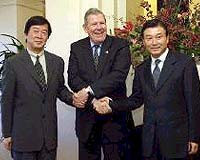
Top officials from the United States, Japan and South Korea Tuesday began talks in San Francisco to seek ways to kickstart their deadlocked dialogue with communist North Korea, officials said.
Senior bureaucrats from the three Asian regional powers huddled in a hotel here to discuss how to lure the unpredictable state back to the negotiating table following the collapse of its talks with rival South Korea.
“We are in a stalemate with every aspect of our efforts to engage Pyongyang so we need to see if we can find a way out of that stalemate,” a Washington-based South Korean diplomat told AFP.
“We will also be discussing how to proceed with our humanitarian assistance to North Korea, but we do not expect any specific action-oriented measures to emerge from this routine meeting,” he added, speaking on condition of anonymity.
Following a historic thawing in ties last year between North and South Korea, split in 1953 after a bitter three-year civil war, the Stalinist hermit state has once again withdrawn into belligerent isolation.
Crucial talks between the Cold War foes broke down two weeks ago amid Pyongyang’s fury over Seoul’s decision to put its military and police on alert following the September 11 terrorist attacks on the United States.
The North publicly lambasted the move, saying it heightened military tensions between the two rivals. South Korea is home to around 37,000 US troops, a force which Pyongyang wants to see leave the region.
The rupture of the negotiations put on ice hopes for future reunions of Korean families separated by the Korean War and those of an inter-Korean agreement on furthering economic cooperation.
The government of South Korean President Kim Dae-Jung began reaching out to the North when it came to power in early 1998.
The so-called Sunshine Policy of engagement finally produced a historic summit between the leaders of the two Koreas in 2000, but since then the rapprochement has slowed dramatically.
The administration of US President George W. Bush took a much tougher public approach to North Korea when it came to office early this year, infuriating the super-sensitive regime in Pyongyang and putting a damper on North-South ties.
Officials in Seoul say that the South Korean delegation to the San Francisco talks will be quietly pressuring Washington to take a softer public stance towards North Korea in order to help draw the North out of its shell.
Bush renewed his tough stance Monday when he called on the North to permit foreign inspectors to verify that it is not producing weapons of mass destruction, and warned Pyongyang to halt foreign missile sales.
Under a 1994 deal which averted a conflict between Washington and Pyongyang, North Korea agreed to freeze its nuclear program, suspected of producing weapons-grade plutonium, in exchange for the construction of new, safer reactors to be built by a US-led consortium.
The Trilateral Coordination and Oversight Group met Tuesday to harmonize policy towards North Korea following the breakdown in dialogue and to discuss how to provide further food aid to the starving state.
The group meets routinely every few months to coordinate North Korea policy but does not usually produce any concrete resolutions.
The US team to Tuesday’s talks here is led by Assistant Secretary of State for East Asian and Pacific Affairs James Kelly.
South Korea’s Deputy Foreign Minister Yim Sung Joon and the director general of the Japanese Foreign Ministry’s Asian and Oceanic affairs bureau, Hitoshi Tanaka, will represent their nations at the round.
All rights reserved. ¿ 2000 Agence France-Presse. Sections of the information displayed on this page (dispatches, photographs, logos) are protected by intellectual property rights owned by Agence France-Presse. As a consequence, you may not copy, reproduce, modify, transmit, publish, display or in any way commercially exploit any of the content of this section without the prior written consent of Agence France-Presse.
