
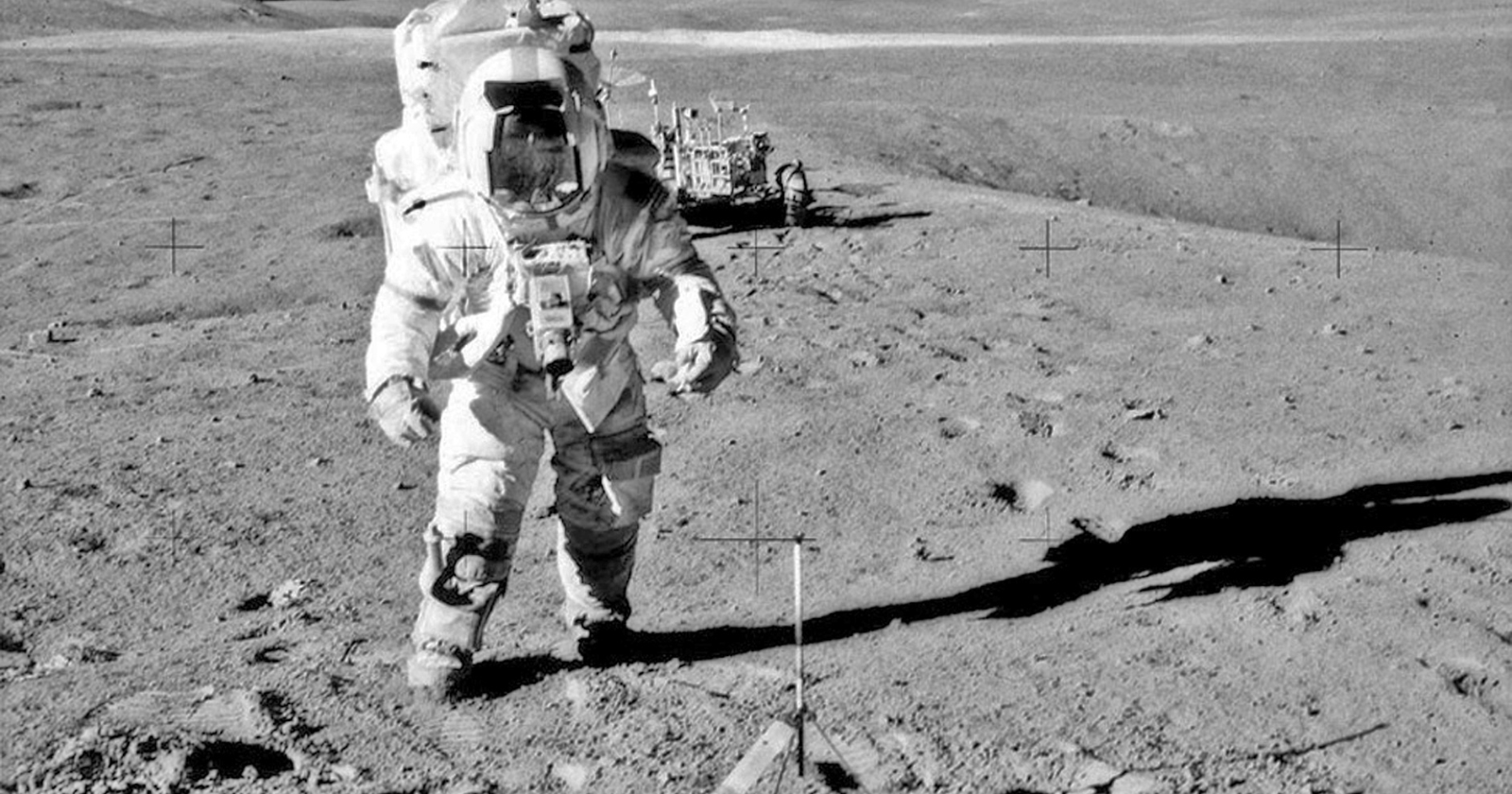
Every astronaut who walked on the moon and returned to a pressurised cabin noticed a smell. The descriptions are not identical, but they cluster around the same image. Spent gunpowder. The ash of a wood fire after water has been thrown over it. The air after a firecracker has gone off in a closed room.
The dust did not smell on the surface. Helmets were on, and the moon has no atmosphere to carry an odour to a nose in the first place. The smell appeared only after the lunar module was repressurised and the helmets came off, with regolith still clinging to suits, boots, gloves, and equipment that the crews had been unable to brush clean.
This is not a new observation. It was logged by Apollo crews more than fifty years ago. What remains unsettled is the chemistry behind it.
What the astronauts actually reported
Apollo 17’s Jack Schmitt is the most quoted source on the smell, partly because he was the only trained geologist to walk on the moon. According to Space.com’s reporting on the lunar aroma, Schmitt said all the moonwalkers landed on the same comparison once their helmets were off, and his first remark about gunpowder came almost exactly seven minutes after the lander’s repressurisation began.
Buzz Aldrin, in his memoir Magnificent Desolation and in later interviews, described it differently. To him the smell was like burnt charcoal, or the ashes of a fireplace once a little water had been sprinkled over them. Charlie Duke of Apollo 16 also recalled a strong, distinct odour as soon as the cabin was sealed again, and Apollo 17’s Gene Cernan repeated the gunpowder comparison in his own debrief.
The crews were not surprised by everything about the moon. They were surprised by this.
The dangling-bonds explanation
The most commonly cited account comes from Larry Taylor, who directed the Planetary Geosciences Institute at the University of Tennessee and worked in the support room at NASA’s Johnson Space Center during Apollo 17. Taylor argued that lunar regolith is unusual at the molecular level because of how it is made.
The moon has no weathering of the kind that smooths rock on Earth. Instead, the surface has been ground down over billions of years by meteoroid impacts. Each impact is small, but the cumulative effect is to leave a layer of jagged, fragmented particles whose chemical bonds were broken and never had a chance to reattach to anything. On Earth, those broken bonds would find oxygen or water within seconds. On the moon, in vacuum, they remain unsatisfied for very long timescales.
Taylor’s proposal, reported in CBS News and other outlets covering the Apollo recollections, is that the astronauts were smelling the rapid satisfaction of those bonds. The moment the dust met the oxygen and moisture in the cabin air, and then the moisture in the lining of the nose, the unsatisfied bonds reacted. The reaction released whatever it released, and the olfactory system interpreted it as gunpowder.
Schmitt himself has endorsed something close to this view, suggesting in correspondence that the olfactory response was to a variety of unsatisfied electron bonds, of a kind also present in just-fired gunpowder.
Why the dust does not smell on Earth
The samples returned by Apollo have not reproduced the smell in any laboratory. There is a straightforward reason for this. NASA’s curation protocols at Johnson Space Center store lunar samples in nitrogen-purged cabinets, with the gas held at slightly higher pressure than the surrounding room so nothing from Earth’s atmosphere can drift in. Part of the point of the protocol is to prevent contamination and atmospheric reactions that could alter the samples, including the kinds of reactions suspected of producing the gunpowder impression in the lunar module.
Any sample exposed to Earth’s air for long enough to be sniffed would already have reacted.
In our reading of the historical record, the dangling-bonds account is the cleanest hypothesis, but it is not the only one. Alternative explanations have been raised over the years, including solar-wind-implanted compounds, sulfur-bearing minerals on the broken particle surfaces, and oxidation reactions involving nanophase iron embedded in the glassy coatings of regolith grains. This is one hypothesis with broad support, not a settled finding.
Why this matters for missions after Apollo
The smell itself is a curiosity. The chemistry that produces it is not. Lunar dust adheres aggressively to suits, seals, and filters, and its sharp, reactive particles are now treated as a serious operational and health concern for any surface programme planning longer stays than Apollo’s brief visits. A review of lunar dust toxicity research published in npj Microgravity notes that the same surface reactivity that may have produced the cabin odour also creates a population of particles with dangling chemical bonds and reactive iron at the grain surface, both of which are relevant to how the dust interacts with human tissue.
For Artemis, and for the commercial lunar programmes intending to operate on the surface beyond a few days, dust handling has moved from a footnote to a recurring engineering line item. Cabin filtration, suit design, airlock procedures, and medical monitoring all have to take account of a material whose chemistry was not understood when Apollo brought the first samples home.
The Apollo moonwalkers remain the only people to have brought fresh lunar regolith back into a pressurised cabin and described what followed. Until someone steps into a lunar lander, takes off a helmet, and reports what they notice, the gunpowder description remains a small piece of unfinished business in the chemistry of the moon’s surface.
