
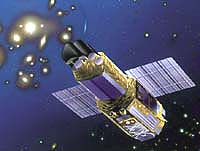
Astro-E, a Japanese-U.S. X-ray mission designed to measure the energies of individual X-rays with increased precision, was apparently lost following launch from the Kagoshima Space Center in Japan at 8:30 p.m. EST Wednesday, Feb. 9.
The prime instrument on Astro-E was the X-ray Spectrometer (XRS), developed jointly by NASA’s Goddard Space Flight Center, Greenbelt, Md. and Japan’s Institute of Space and Astronautical Science (ISAS). The XRS measures heat created by individual X-ray photons.
Along with the XRS were four X-ray Imaging Spectrometer (XIS) instruments, a collaboration among Japanese universities and institutions and the Massachusetts Institute of Technology Center for Space Research, and the Hard X-ray Detector (HXD), built by the University of Tokyo and ISAS.
Due to a problem with the first stage of the M-5 rocket, Astro-E did not reach orbit. Astro-E was to join the recently launched European X-ray Multi-Mirror Mission (XMM) satellite and NASA’s Chandra X-ray Observatory to ring in a new era of X-ray astronomy. The NASA cost for instrument development was $44.9 million.
In terms of science, the loss of Astro-E leaves a void in the understanding of higher-energy X-ray sources, such as galaxy clusters and supernova remnants and of supermassive black holes, which reveal their secrets in the iron atom emissions that Astro-E would have resolved so clearly.
Astro-E was also the test bed for the X-ray calorimeter, a key component in future X-ray missions. The X-ray calorimeter (the sensor part of XRS) is a new technology that measures the heat deposited by incoming X-ray photons. This technology has been tested on balloons. Astro-E was to be the first long-term test in the harsh environment of space.
NASA has cooperated with ISAS on very complex and important space science missions, and planning and work on future missions together continues.
