

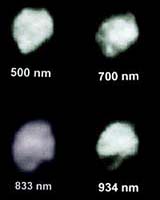
If someone sneaks a bite of your chocolate chip cookie, they leave behind evidence of their pilferage in the form of a crescent of missing cookie. The same is true in our solar system, where an impact can take a bite out of a planet or moon, leaving behind evidence in the form of a crater. By combining modern technology with a historical telescope, astronomers have discovered that the asteroid Juno has a bite out of it. The first direct images of the surface of Juno show that it is scarred by a fresh impact crater.
Juno, the third asteroid ever discovered, was first spotted by astronomers early in the 19th century. It orbits the Sun with thousands of other bits of space rock in the main asteroid belt between Mars and Jupiter. One of the largest asteroids, at a size of 150 miles across, Juno essentially is a leftover building block of the solar system.
Astronomer Sallie Baliunas (Harvard-Smithsonian Center for Astrophysics) and colleagues photographed Juno when it was located relatively nearby in astronomical terms, about 10 percent further from the Earth than the Earth is from the Sun. Even at that distance, Juno appeared very tiny in the sky, subtending only 330 milli-arcseconds – the equivalent of a dime seen at a distance of 7 miles. Imaging Juno at the high resolution needed to resolve surface details thus presented a challenge.
To solve the problem, the scientists used an adaptive optics system connected to the 100-inch Hooker telescope at Mount Wilson Observatory. Adaptive optics enables astronomers to compensate for the distortion created by air currents in our planet’s atmosphere, yielding images as sharp and clear as those taken in space.
