
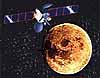
The AsiaSat HGS-1 spacecraft became the first commercial communications satellite to orbit the moon, passing behind it at noon PDT Wednesday to grab a boost from lunar gravity and hurtle back toward Earth. Engineers at the Hughes Mission Control Center in El Segundo, Calif., will begin braking maneuvers Saturday to guide the arriving spacecraft into orbit around the equator.
HGS-1 is a high-power satellite built by Hughes Space and
Communications Co. of Los Angeles, and owned by its subsidiary, Hughes
Global Services Inc. (HGS). It was designed to provide television and
other telecommunications services for Asia and neighboring regions.
During launch last Christmas Day, however, the rocket that was
carrying it malfunctioned, leaving the satellite in an unusable,
highly inclined, elliptical orbit. The original owner of the
spacecraft filed an insurance claim, and the insurers declared the
mission a total loss for its original purposes.
Hughes scientists and engineers weren’t ready to give up on the
fully functional satellite, however. They devised a salvage mission
using the moon’s gravity to reposition the satellite into a usable
circular orbit 22,300 miles above the equator, called geosynchronous
orbit.
It is the first known lunar mission involving a communications
satellite and the first lunar mission financed by a non-governmental
entity. If Hughes can put the HS 601HP model satellite into a useful
revenue-generating orbit, it has agreed to share profits with the
insurers.
HGS-1 began its lunar encounter at 11:52 a.m. PDT Wednesday.
Occultation — the period during which it was behind the moon and out
of radio contact with ground controllers — lasted until 12:20 p.m.
The satellite came within 3,883 miles of the moon’s surface — called
perilune — at 12:55 p.m. It’s now on a 3-day return trip to Earth.
Over the next three days, Hughes controllers will prepare the
satellite for a retro burn that will slow HGS-1 as it approaches
geosynchronous orbit. The spacecraft is expected to execute the
maneuvers around 8 p.m. PDT Saturday. Controllers are using satellite
ground stations, optical telescopes and radar facilities around the
world to track the spacecraft.
Hughes began the mission April 10, firing the satellite’s onboard
rocket motor several times to raise its altitude. The 12th firing was
May 7, giving HGS-1 its final kick toward the moon.
Hughes Space and Communications, a unit of Hughes Electronics
Corp., has been building communications and scientific spacecraft and
instruments for more than 35 years. It is the world leader in
manufacturing commercial geostationary communications satellites.
Hughes Global Services packages commercial satellite services for
government and military customers. HGS also works with other Hughes
Electronics companies to provide end-to-end solutions for underserved
commercial markets.
PanAmSat Corp., of which Hughes Electronics is the majority
owner, has been providing critical command and tracking support for
the mission through its teleport in Fillmore, Calif. The earnings of
Hughes Electronics are used to calculate the earnings per share
attributable to GMH common stock.
