

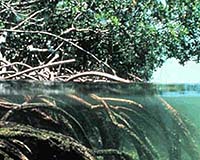
Asian governments are failing properly to restore coastal mangrove forests damaged in the tsunami, which saved lives and homes by absorbing the force of the waves, experts said Tuesday.
Besides acting as a physical barrier to coastal communities, mangroves reduced the deadly swirl of debris and provided anchors for people to cling to, international wetlands expert Faizal Parish told a conference here.
But he said that the forests, which apart from their vital role in the tsunami are also important ecological areas, have not been properly revitalised by affected nations.
“People have rushed out and planted mangroves and said, ‘Now we have greened the coastal area’, and I think there is a danger these projects will fail,” he said at an international conference on mangrove and coastal ecosystems.
“Clearly more effort needs to be done very quickly in the next three to six months to focus on getting the strategy right,” said Faizal, who is director of the Malaysia-based Global Environment Centre.
Faizal said governments must move beyond the initial aid phase, which focused on human assistance, to addressing coastal environments.
“From the observations that we’ve made in Aceh and other places, we feel that the assistance is not sufficient in that area and the assistance which has been given is not sufficiently well-directed,” he said.
“We have seen a lot of efforts of people very rapidly putting some mangrove seedlings into areas which have been impacted without looking at appropriate species, appropriate placement.”
Scientists at the conference said that while Asian governments recognise the usefulness of creating coastal “green belts”, better long-term planning is needed.
They highlighted the planting of tree species with low tolerance for the salty soil created by the tsunami disaster, which resulted in many trees dying.
Another issue facing governments is the cost of rehabilitating coastal areas, with some countries like Indonesia needing international assistance.
Faizal said roughly 30 to 40 million dollars was needed to reinvigorate 1,300 kilometres (890 miles) of damaged coastline.
The December 26 Indian Ocean tsunamis killed an estimated 217,000 people in countries including Indonesia, Thailand, India and Sri Lanka and caused billions of dollars in damage.
