
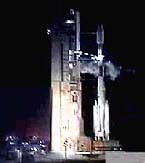
A European Ariane rocket carrying a Japanese telecoms satellite blasted off from the launch site at Kourou, French Guiana, at 10.04 p.m. Thursday (0104 GMT Friday), the European Space Agency’s marketing arm Arianespace announced.
The launch had been delayed for 24 hours due to bad weather.
The Ariane rocket was taking up the four-tonne Superbird-4 satellite, owned by Japan’s Space Communications Corporation (SCC), placing it in geostationary orbit above the Pacific Ocean.
Superbird-4 is designed to provide digital TV transmission, data and Internet links across Japan.
The eastern satellite tracking station in Sydney, Australia, received signals from the satellite about 56 minutes after launch, indicating systems are operating normally.
 Superbird-4, is a high-power HS 601 satellite built by Hughes Space Communications, and will join the existing SCC constellation and be located at 162 degrees East longitude.
It carries 23 Ku-band and 6 Ka-band transponders, as well as a steerable Ku-band spot beam. Superbird-4 is expected to begin initial operations in early April 2000.
“With tonight’s successful launch, Hughes Space and Communications has enabled SCC to expand its services well into the new century,” announced HSC President and CEO Tig H. Krekel.
“As our customers’ requirements increase, HSC is ready to meet the challenge and provide the best satellite systems anywhere. HSC is proud to partner with SCC to bring improved satcom services to Japan and the Asia-Pacific region,” he added.
Superbird-4 is the 184th Hughes-built spacecraft to be launched. To date, 53 Hughes HS 601 satellites have been launched, and 14 of those, including Superbird-4, are the high-power version.
Superbird-4 is the second HSC satellite built for SCC. Her sister satellite, Superbird-C, an HS 601, was successfully launched in July 1997.
AFP Paris correspondents contributed to this report
