

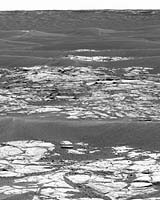
Opportunity is healthy and continuing its drive toward “Erebus Crater.” Images taken last week show the interior of the crater. Plans for the next few sols are to get closer to the crater’s edge and do extensive imaging.
The team is also planning to use the tools on the robotic arm to examine a dark area of outcrop located on the way to the edge of the crater.
Sol-by-sol summaries
Sol 586 (Sept. 16, 2005): Opportunity conducted remote sensing.
Sol 587: More remote sensing. Sol 588: Drove about 20 meters (66 feet) at 208 degrees.
Sol 589: Drove about 22 meters (72 feet). Sol 590: Drove 35 meters (115 feet).
Sol 591 (Sept. 22, 2005): Drove about 17.5 meters (57 feet), turned for weekend work with robotic arm.
As of sol 591, Opportunity has traveled 5,933.69 meters (3.69 miles).
Meanwhile, the MER team has produced a beautiful mosaic of the view as Opportunity nears Crater Erebus.
In this mosaic assembled from some of the images taken by the panoramic camera on Sept. 21, 2005 (Sol 590) the view is towards the south and includes rock exposures north of “Erebus Crater,” with the crater in the background.
The rover will investigate the exposed rocks in the foreground and will take additional panoramic-camera images of Erebus Crater, which is about 300 meters (about 984 feet) across.
Erebus Crater dwarfs the landing-site crater, “Eagle Crater,” which measures about 22 meters (72 feet) in diameter. And, it is nearly twice the diameter of “Endurance Crater,” which, at 130 meters (430 feet) wide, has been compared to a stadium.
The camera’s red filter was used for taking the images in this mosaic. It admits light with a wavelength of 750 nanometers.
