
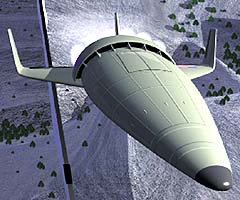
Andrews Space & Technology has been awarded a contract by the National Aeronautics and Space Administration to conduct a Future Space Transportation Study that will analyze emerging space markets and their transportation needs.
The initial four-month study by Andrews Space & Technology supports NASA’s work to define how the agency can get into space more safely and for less money using a second-generation reusable launch vehicle (RLV) than is possible today traveling on the Space Shuttle, a first-generation vehicle.
The study is being funded by NASA’s Research Announcement effort known as the Second Generation RLV Risk Reduction Definition Program. Under this same program, Andrews Space & Technology, with headquarters in El Segundo, Calif., won another six-month contract from Kelly Space & Technology of San Bernardino, Calif., to perform systems engineering and detailed design activities in support of Kelly Space’s Second Generation RLV Risk Reduction contract.
Andrews Space & Technology was awarded both contracts, worth nearly half-a-million dollars, last month. “We are very excited and honored to be working on NASA’s Second-Generation RLV Program,” said company president Jason Andrews. “We believe that the study of emerging space markets is critical to designing a RLV that is going to operate commercially in the 2010 to 2030 time frame.”
Future Space Transportation Study Overview:
Andrews Space & Technology’s tasks for the Future Space Transportation Study, a multiphase effort, include: identifying non-aerospace companies that could profit from doing business in space; interviewing select companies to better understand how they could do business in orbit; developing commercial business models for their respective industry niches; and characterizing market size and elasticity.
The study also will include deriving market-driven, second-generation RLV system design requirements to address potential emerging space markets. The markets to be researched in this initial study phase are on-orbit microchip fabrication, materials development and processing, pharmaceutical manufacturing development and other biomedical and clinical applications.
Future study phases will address space tourism, orbit logistics, space traffic management and orbital infrastructure.
Leading the Future Space Transportation Study is Dr. Dana Andrews, the company’s Chief Technology Officer, who joined Andrews Space & Technology last march. Dr. Andrews was formerly with the Boeing Company for 34 years, where he lead major space design projects including the Boeing TSTO RLV, Future-X, Military Space Plane and Solar-Thermal Orbital Transfer Vehicle (SOTV) programs.
Along with performing technical market analysis in the study, Andrews Space & Technology will produce a video “trailer” characterizing future commercial space activities and conducting business in orbit.
The video trailer will be used in conjunction with focused, industry-specific multimedia presentations to inform the respective industries and the general public about how NASA’s goals of significantly improving safety and reducing the cost to orbit could facilitate a space commerce, referred to by the company as “s-commerce,” revolution and benefit terrestrial business opportunities.
Andrews Space & Technology will be assisted with its Future Space Transportation Study by these subcontractors: ECON Inc. of Huntington Beach, Calif., which will perform economic analysis and cost estimating; and Digital Empire Inc. of Riverside, Calif., which will provide animation, visualization and communications integration for the video trailer, multimedia presentations and other project deliverables.
NASA’s Second Generation RLV Program:
Both contracts awarded to Andrews Space & Technology in July fall under NASA’s Second-Generation RLV Risk Reduction Definition Program, which is part of the agency’s Space Launch Initiative. The Initiative is designed to increase commercial development and civil exploration of space by making access to space less expensive and safer.
According to NASA program manager Dan Dumbacher, the agency will use the research gained from its Second-Generation RLV Risk Reduction Definition Program to support a NASA-sponsored second-generation RLV competition in 2005.
Along with Andrews Space & Technology and Kelly Space & Technology, other companies chosen to share the $15 million as participants in NASA’s Second Generation RLV Risk Reduction Definition Program are Orbital Sciences Corp., Dulles, Va.; the Boeing Co., Seal Beach, Calif.; Lockheed Martin Space Systems Co., Denver, Colo.; the Boeing Co.’s Rocketdyne Propulsion and Power, Canoga Park, Calif.; Pratt & Whitney, West Palm Beach, Fla.; Futron Corp., Bethesda, Md.; and Space Access, Palmdale, Calif.
Overseeing the program is Marshall Space Flight Center of Huntsville, Ala., NASA’s lead center for Space Transportation Systems Development. The program is a result of NASA’s industry-led Space Transportation Architecture Studies (STAS), which started in August 1998 and ended last May, and NASA’s Integrated Space Transportation Plan (ISTP) developed last fall.
Last year and earlier this year, Andrews Space & Technology performed systems engineering and vehicle design engineering services on behalf of Kelly Space & Technology in support of NASA’s STAS to develop space transportation systems that will serve through the year 2030. NASA incorporated the Team’s findings into its ISTP, which identifies and defines the agency’s five-year investment strategy that will enable a low-risk, highly competitive selection of a new space architecture by 2005.
Andrews Space & Technology was founded in July 1999 by Jason Andrews, company president, and Marian Joh, board chairman and CEO, whose respective experience includes hands-on involvement in developing and financing the Kistler K-1 two-stage-to-orbit and Lockheed Martin VentureStar single-stage-to-orbit RLVs.
