
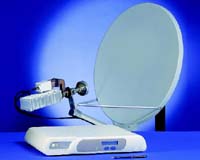
Aloha Networks will introduce several new SkyDSL Network products and performance features at the Satellite 2004 conference. The SkyDSL Router, SkyDSL SAMA Receiver with a 256 kbps return channel, SkyTCP Software for IP acceleration, and the SkyNMS Software for monitoring and managing the SkyDSL Network will be on display at Aloha’s booth, #677.
“The small footprint and low latency of the SkyDSL Router, combined with increased return-channel speed, make the SkyDSL Network an ideal platform for a wide range of satellite broadband applications,” said Stephen Hester, Aloha’s President and COO.
The SkyDSL Network fully supports today’s most popular IP applications, including VoIP, VPN, FTP, Internet browsing, encryption, unicast, and multicast.
The SkyDSL Router, Aloha’s second-generation indoor unit, is designed for either a Ku- or C-band configuration. The unit fits neatly inside a 1U-sized enclosure and includes an integrated router and an auto-ranging internal power supply.
The SkyDSL SAMA Receiver features 256 kbps return channel performance and scalability from tens of sites and users to many thousands without requiring additional hardware. Each subscriber can instantly access the full bandwidth of the return channel.
Aloha’s SkyTCP Software is a fully transparent solution that increases throughput of TCP traffic over a geostationary satellite channel. SkyTCP software enables the SkyDSL Network to ensure maximum efficiency and reliability for IP traffic over satellite.
Aloha’s SkyNMS Software, using SNMP and a graphic interface, tracks SkyDSL Network performance, traffic, and power levels. In addition, the network administrator can remotely configure SkyDSL Routers multicast software updates, and manage network abuse such as undesirable file sharing and virus attacks.
With the SkyDSL Network, broadband access is deployed quickly and effortlessly to global locations. The SkyDSL Network is an ideal satellite broadband solution for energy explorations, international construction sites, finance and banking activities, Internet caf¿s and hot spots, first response and disaster recovery networks, rural broadband telephone systems and distance learning applications.
