
One hundred years ago, Orville and Wilbur Wright set out to solve the problem of flight. Their methodical experimentation with kites and gliders evolved into one of mankind’s greatest inventions — powered aircraft.
What the Wright brothers created in 1903 was a reliable propulsion system producing 12 horsepower that provided the thrust necessary for takeoff, climb and sustained level flight.
Today, as the centennial of their first powered flight on Dec. 17, 1903, draws closer, Air Force Research Laboratory scientists, engineers, contractors, engine manufacturers, and university researchers here continue to expand the envelope of propulsion technologies with their own inventions that push aircraft higher, faster and farther than Orville and Wilbur ever could have imagined.
Celebrating a “Century of Power for Flight,” nearly 700 Defense Department, NASA and aerospace industry participants met recently here to explore and exploit the latest propulsion technology advances that will preserve America’s dominance in the air. The biennial event is sponsored by AFRL’s propulsion directorate.
The forum gave the U.S. turbine engine community a chance to review and discuss the latest technology advances.
And just as the Wright brothers had a clear concept of the role of engines in their aircraft — to provide reliable, sufficient power — their modern day counterparts share that passion.
“We are committed to providing the nation with propulsion and power technologies that will change the future of air, space and weapons,” said Col. Al Janiszewski, propulsion director.
With more than 450 ongoing programs, 1,000 people and an annual budget of more than $300 million, the propulsion directorate provides a complete spectrum of advanced propulsion technologies for the nation’s military services, he said.
Besides providing propulsion technologies for aircraft, rockets and spacecraft, the directorate also conducts leading edge research and development in aerospace fuels, propellants and power-generating systems.
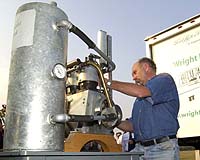
Mixed in with the symposium’s seminars and special presentations on the future of engine durability and warfighter readiness, attendees also got a rare glimpse of their roots with a demonstration of Orville and Wilbur’s 1910 Wright Vertical Four aircraft engine, the only operating original Wright engine in the world.
Owned by the Wright Experience, a nonprofit charitable organization which seeks to rediscover the Wright Brothers experimentation, discovery and methodology, the 92-year-old engine was acquired in 1999 and restored by Greg Cone of Warrenton, Va. Other than minor parts like nuts, bolts and spark plugs, all its parts are original, Cone said.
The “Vertical Four” was the Wrights’ mature engine design, and was the standard powerplant for their most produced airplane, the Model “B” — the world’s first production airplane. Designed by the Wrights and put into production in 1910, it was their most popular aircraft, Cone said.
The engine was started for the first time in 85 years in
2000. Since then, the engine has been demonstrated numerous times, but never to a more appreciative crowd of engine lovers than symposium attendees who share the Wright’s vision to explore the engine technologies that power the future of flight.
“Staying connected with our tremendous heritage is a very real priority in the engine community,” said Janiszewski.
“We do this, first, through events like this working demonstration of the Wright brothers’ engine. But in a much more important way, we do it by sharing the same incredible sense of innovation the Wright brothers displayed by developing revolutionary technologies that make today’s Air Force second to none. We honor our past while creating our future.”
