

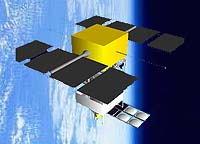
On 24 April 2006, at affiliated locations around the nation, Air Force Space Command (AFSPC) will celebrate the 10th Anniversary of the Midcourse Space Experiment (MSX) satellite.
The locations participating are those engaged in the delivery and operation of the satellite and include AFSPC, the Ballistic Missile Defense Organization (BMDOnow the Missile Defense Agency), the spacecraft builders of the Applied Physics Lab at Johns Hopkins University, the primary sensor builder at the Massachusetts Institute of Technology Lincoln Laboratory and the Utah State University Space Dynamics Laboratory.
MSX was originally a Ballistic Missile Defense Organization (BMDO) experiment with a design life of five years. AFSPC realized the potential of the Space Surveillance capabilities inherent with the Space Based Visible (SBV) sensor and assumed ownership from BMDO on Oct. 2, 2000.
MSX/SBV is AFSPC’s only space-based surveillance asset providing full metric and Space Object Identification coverage of the geosynchronous belt regardless of weather, day/night or moon light limitations. Currently the MSX/SBV supports USSTRATCOM’s Space Control mission by providing valuable Space Situational Awareness data as the only system that can see space from space. The satellite has also contributed to scientific pursuits to include various astronomical experiments on global change of atmospheric gases, studies of the chemistry and physics over the poles, gathering data on space contamination and debris and even galaxy phenomena to include the Hale-Bopp comet and Quasers.
MSX’s continued operational success is the result of close coordination and partnership between multiple government and civilian organizations. Headquarters AFSPC has overall responsibility for the program, 1st Space Control Squadron provides mission tasking, and 1st Space Operations Squadron provides orbit determination and scheduling of the Air Force Satellite Control Network to support MSX flight operations. The Applied Physics Laboratory at Johns Hopkins University built, maintains and operates the satellite bus and Massachusetts Institute of Technology Lincoln Labs built and operates the SBV Sensor.
