
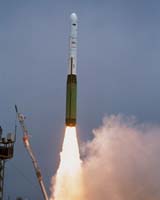
Orbital Sciences Corp. announced it has received a $23 million U.S. Air Force contract for two Minotaur I space launch vehicles under the Rocket System Launch Program. The two missions will launch the TacSat-2 and TacSat-3 satellites in 2006 and 2007, respectively, the company said in a statement.
The TacSat-2 launch is designed to demonstrate Orbital’s ability to carry out an operationally responsive launch service just six months after the contract award. The second launch is scheduled to take place within a year of the first launch, currently scheduled for September 2007.
Last month, Orbital launched six FORMOSAT satellites for the Republic of Taiwan into low-Earth orbit aboard a Minotaur I rocket in a mission originating at Vandenberg Air Force Base in California.
The TacSat-2 mission will be the sixth space launch of a Minotaur I rocket. All five previous missions were successful, the company’s statement said.
TacSat-2 and -3 are among a series of experimental spacecraft designed to demonstrate new technologies and capabilities for providing responsive space-based support of military operations.
The TacSat series, plus the quick-reaction Minotaur I launches, are intended to become key parts of the U.S. military’s effort to develop Operationally Responsive Space systems. The Air Force Research Laboratory at Kirtland Air Force Base in New Mexico is leading the TacSat-2 and -3 joint development teams, in partnerships that include space organizations from the Air Force, Navy and Army.
The rockets that will launch TacSat-2 and -3 are the seventh and eighth Minotaur I rockets to be ordered by the Air Force and are the 18th and 19th orders placed for the complete Minotaur family of launch vehicles.
The Minotaur I made its inaugural flight in January 2000, successfully delivering multiple small military and university satellites into orbit. Its second mission was carried out less than six months later with the launch of the MightySat II technology demonstration satellite for the AFRL in May 2000.
The most recent three missions were all conducted within a one-year period, beginning with the April 2005 launch of the XSS-11 spacecraft for AFRL. That mission was closely followed by the launch of a classified DARPA satellite in September 2005.
