

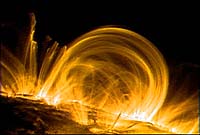
The American Geophysical Union will soon launch the first journal devoted to the emerging field of space weather and its impact on technical systems, including telecommunications, electric power, and satellite navigation. Space Weather: The International Journal of Research and Applications will present peer-reviewed research, as well as news, features, and opinion articles.
Louis J. Lanzerotti has been named Editor of Space Weather.
Lanzerotti is consulting physicist at Lucent Technologies’ Bell Laboratories and distinguished research professor at the New Jersey Institute of Technology.
“The initiation of Space Weather recognizes the fact that the ever-increasing sophistication of technical systems within or under the influence of the Earth’s space environment requires a forum where engineers, systems designers, scientists, and managers can obtain the latest information and discuss new developments,” Lanzerotti said.
Peer-reviewed articles will present the latest engineering and science research in the field, including studies of the response of technical systems to specific space weather events, predictions of detrimental space weather impacts, and effects of natural radiation on aerospace systems.
News and feature articles will provide up-to- date coverage of government agency initiatives worldwide and space weather activities of the commercial sector. The editor will be assisted by a distinguished Board of Advisors.
Space Weather will be published as an online AGU journal. A quarterly magazine digest will also be published and distributed free of charge to space weather professionals.
Lanzerotti recently served as chair of the National Research Council’s Decadal Survey Committee on Solar and Space Physics and also serves on the Governing Board of the American Institute of Physics. He is the author or co-author of more than 500 publications, many related to the effects of space weather on communications.
AGU has received a grant from the National Science Foundation’s Division of Atmospheric Sciences to help support the launch of Space Weather.
