

US defense chiefs are reviewing draft legislation proposed by the administration to try “war on terror” detainees under new rules rather than under existing military law, a spokesman said Wednesday.
The spokesman said he could not confirm a New York Times report that the proposal would allow hearsay evidence to be introduced unless deemed “unreliable” and permit defendants to be excluded from their own trial if deemed necessary for national security.
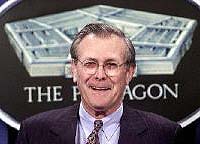
US Defense Secretary Donald Rumsfeld has asked that the draft be reviewed by the chiefs of the military services, the services’ top military lawyers, civilian service secretaries and their general counsel, said Eric Ruff, the Pentagon press secretary.
“He has asked them to review not only legal aspects (of the draft) but also policy,” Ruff said.
Military lawyers have been among the sharpest critics of the military commission system, fearing it will undermine legal protections for US service members.
Ruff said the legislative draft was produced in response to a Supreme Court ruling last month which declared that Bush had overstepped his authority in forming military commissions to try detainees held at Guantanamo Bay, Cuba.
The court also held that the commission trials and the special rules created for them violated the Geneva Conventions and the US Code of Military Justice (UCMJ), the body of law under which military cases are tried.
According to the Times, which obtained a copy of the bill, the proposal preserves the military commissions while drawing from the UCMJ to expand certain protections.
But the Times said the draft measure describes court-martial procedure as “not practicable in trying enemy combatants,” because doing so would “require the government to share classified information” and would exclude “hearsay evidence determined to be probative and reliable.”
In addition, The New York Times said, instead of requiring speedy trials, the draft bill would allow terrorist suspects to “be tried and punished at any time without limitations.”
The proposal also said that the Geneva Conventions “are not a source of judicially enforceable individual rights,” meaning that people convicted of terrorist acts would be prevented from suing the US government for violating their Geneva Conventions rights.
