Walk through a doorway in a dark house and your skin will not register the frame passing over it. No click announces it, no change in air pressure gives it away.
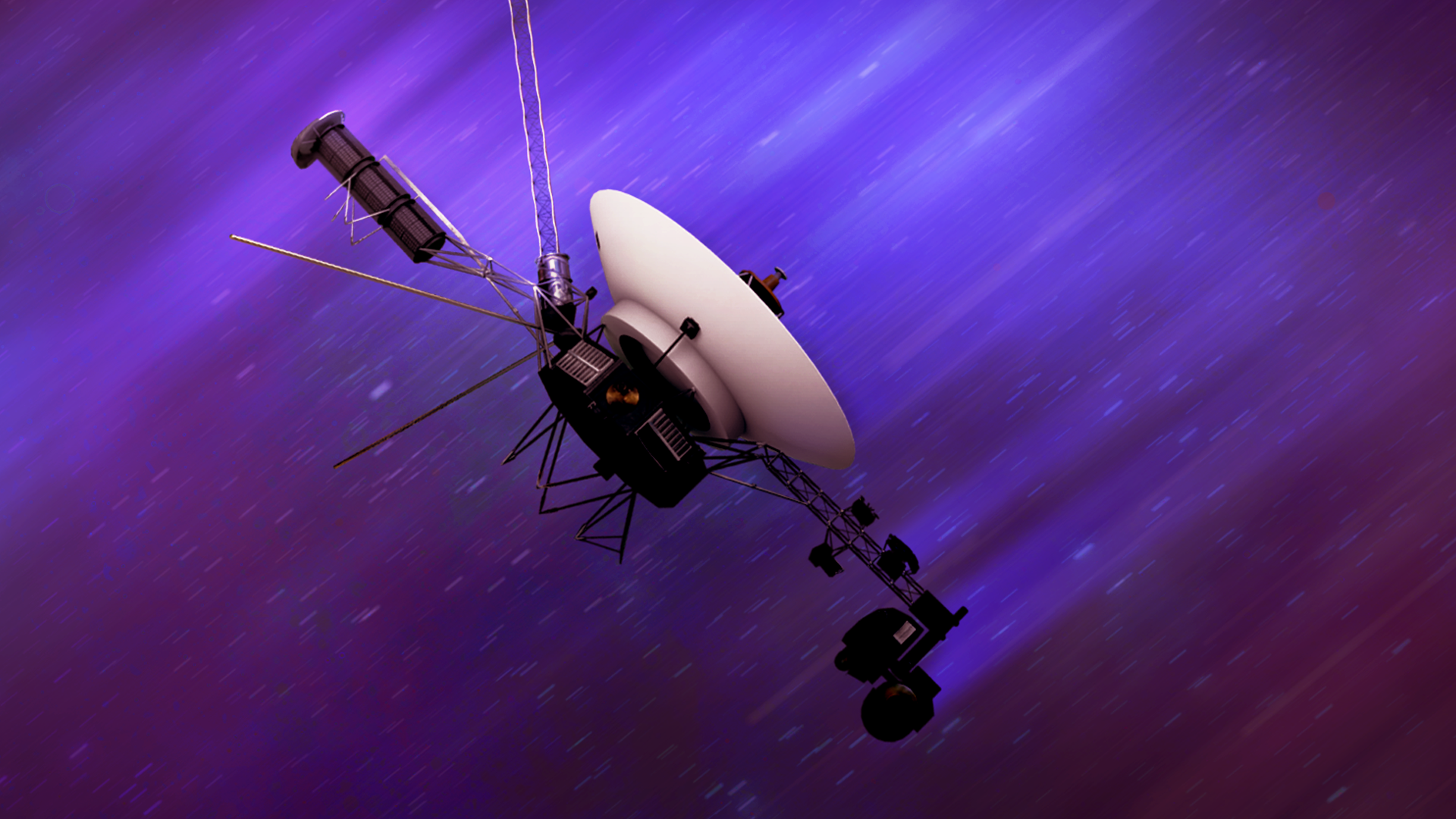
The only proof you have entered a new room may be a change you can measure once you are inside it. Voyager 1 crossed the heliopause in a similarly indirect way: there was no physical wall or instantaneous announcement, so the mission team assembled evidence from several surviving instruments.
That threshold is the heliopause, the outer skin of the bubble the sun blows around our entire solar system. Inside it, the solar wind, a steady outflow of charged particles from the sun, pushes back against the thin gas drifting between stars. At the heliopause, that push finally loses. Cross it and you are no longer in the sun’s neighborhood. You are in the interstellar medium, the space between star systems.
Nobody designed a way to feel that line directly. No wall marks it, no membrane, nothing a spacecraft could bump into. The only way to know which side you are on is to read the density of the plasma around you, since interstellar gas is measurably thicker than the thin wind inside the bubble.
The direct plasma instrument was no longer usable
Voyager 1 actually carried an instrument built for exactly that reading. The Plasma Science instrument, known as PLS, was designed and built at MIT in the 1970s under physicist Herbert Bridge, meant to measure the density, speed, and temperature of the charged particles flowing past the spacecraft using four detector cups.
It flew past Jupiter in March of 1979 and Saturn that November of 1980, and it worked exactly as intended through both encounters. Then its usefulness for the one measurement everyone would eventually need started slipping away. NASA’s own mission history states plainly that the instrument “stopped working in 1980 and was turned off in 2007 to save power,” a quiet, undramatic sentence for the failure of the one sensor purpose built to say, without ambiguity, when Voyager finally left home.
The loss was gradual rather than dramatic. By the time the heliopause crossing became the central question, the mission had to rely on other surviving measurements. The video below explains how plasma-wave data helped provide that evidence.
The Plasma Science instrument degraded long before the crossing occurred. John Richardson, the MIT physicist who inherited the role of principal investigator, later noted that Voyager 2’s corresponding instrument—whose geometry remained useful—was not designed for the local interstellar medium but continued to measure interstellar plasma currents beyond the heliosphere. Voyager 1, however, needed an indirect route to the density measurement.
A second instrument provides an indirect measurement
The instrument that supplied the crucial density evidence was the Plasma Wave Subsystem, one of Voyager’s original science instruments. It was built to detect plasma waves and low-frequency radio phenomena during the planetary mission, not to sample particles directly. In the extended mission it remained scientifically useful: the frequency of electron oscillations around the spacecraft can be used to infer electron density. NASA continues to operate the subsystem for plasma-wave observations. Its longevity was valuable, and there is no evidence that its continued operation resulted from neglect.
Here is why an instrument built for planetary flybys turned out to be usable at interstellar distances at all. Disturb a cloud of electrons and it rings, the same way a struck bell rings, at a note called the plasma frequency. That note rises and falls with how tightly packed the electrons are. Pack them closer and the pitch climbs. The instrument does not need to be pointed at anything or aimed at a source. It only needs charged particles nearby to disturb, and interstellar space, empty as it looks, still has those.
In April of 2013, the instrument recorded electron plasma oscillations triggered by a solar disturbance that had spent months crossing the gap between the sun and the spacecraft, and the reading corresponded to an electron density roughly forty times greater than anything measured inside the heliosphere. Don Gurnett, the University of Iowa physicist who had led the instrument’s design since Voyager launched, called it plainly: “This is the first solid evidence that Voyager 1 has crossed the heliopause.”
Reading a crossing that happened a year earlier
The confirming signal arrived well after the crossing. A solar outburst had to travel outward and excite the surrounding plasma strongly enough for Voyager to register it. Measurements from late 2012 and spring 2013 allowed the team to date the crossing to 25 August 2012. The Plasma Wave Subsystem had provided an indirect density measurement through a physical process that was useful far beyond its original planetary encounters.
“Now that we’re on the outside, we are learning that interstellar space isn’t a bland region,” Bill Kurth, another University of Iowa physicist on the instrument team, said after readings from beyond the boundary began arriving. An instrument developed for Voyager’s planetary mission had proved capable of useful measurements in a region no spacecraft had sampled before.
Correction, 31 August 2026: An earlier headline placed both of Voyager 1’s planetary flybys in 1980; Jupiter was in 1979 and Saturn in 1980. The article also characterised the continued operation of the Plasma Wave Subsystem as an afterthought without evidence.