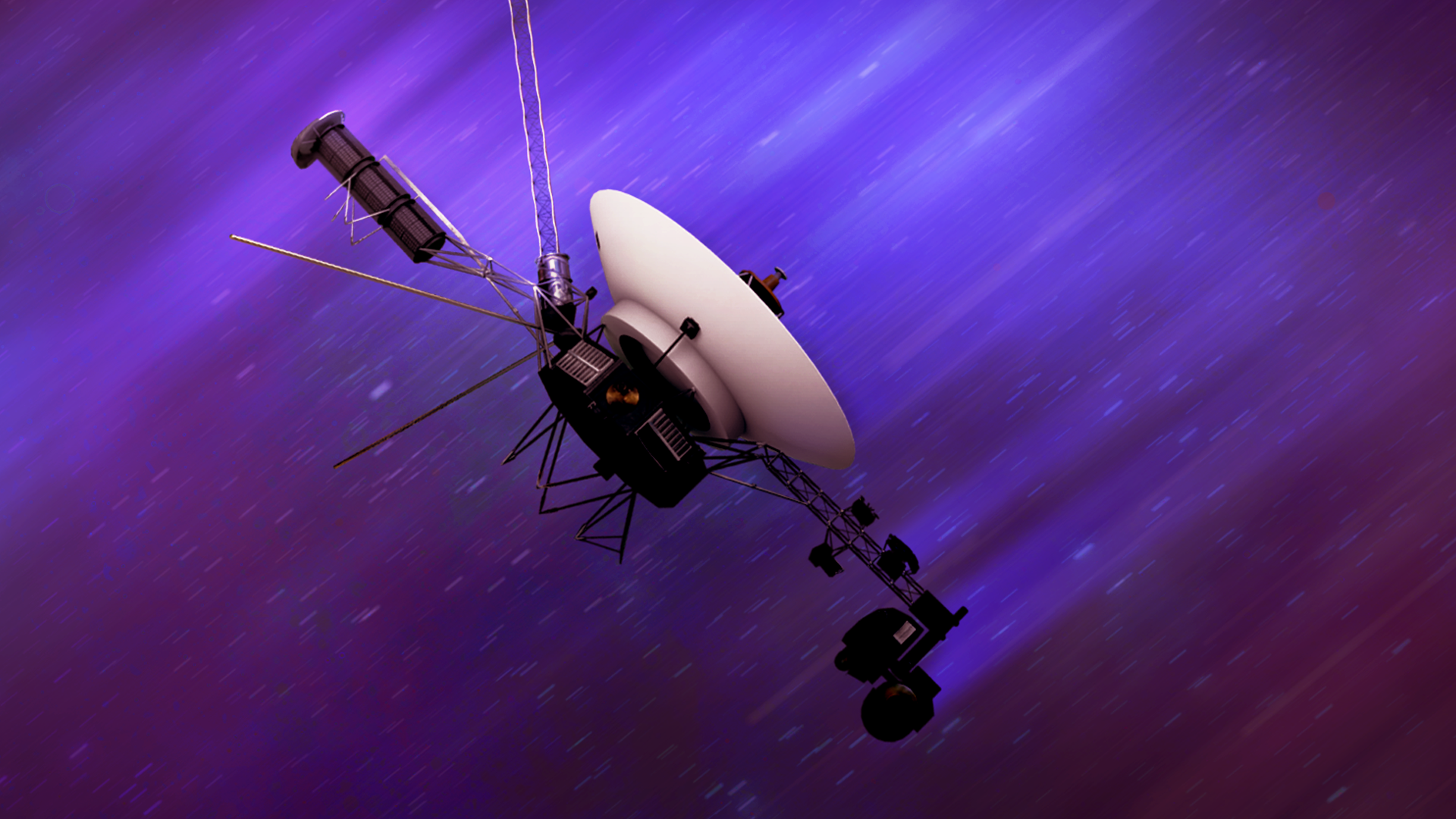
“In space, no one can hear you scream.” Alien’s tagline is one of the most quoted lines in movie history, and scientifically, it holds up.
Sound needs a material medium in which pressure waves can travel, and the extremely thin gas between stars cannot carry an audible signal to a human ear. Voyager 1 does not record acoustic sound. Its Plasma Wave Subsystem measures electrical oscillations of electrons in ionised gas, and some of those oscillations occur at frequencies within the range of human hearing.
Because the measured variations already occur at audio frequencies, the data can be amplified and played through a loudspeaker without shifting their pitch. That makes the plasma-wave measurement audible, but it does not mean sound was propagating through the vacuum to the spacecraft.
Interstellar space is nearly empty, not actually empty
The region between star systems isn’t a true vacuum. It holds a thin scatter of ionized gas, atoms stripped of some of their electrons, drifting at a density so low it would count as a hard vacuum in any lab on Earth. But low is not zero. Those loose electrons are still there, still capable of being disturbed, still able to respond when something pushes on them. That handful of charged particles per cubic centimeter is the entire reason this story is possible at all.
Those electrical measurements are the basis of the recording in the video below. The changing pitch reflects changes in electron density as Voyager 1 travelled beyond the Sun’s heliosphere.
Disturb the plasma and its electrons oscillate
When electrons in a plasma are disturbed, they can oscillate at a characteristic plasma frequency. The frequency depends on electron density: a denser plasma produces a higher frequency. Measuring that frequency therefore gives scientists an indirect reading of the gas density around the spacecraft.
That note happens to land inside the range of a human ear
This is the detail that turns a piece of physics into something you can actually experience. In the interstellar medium, that ringing falls between roughly a few hundred and a few thousand hertz, well within the roughly 20 hertz to 20,000 hertz range human hearing covers. No human ear could detect these plasma waves directly, but because they land at audio frequencies, “we can play the data through a loudspeaker and listen,” says Don Gurnett, the University of Iowa physicist who built and ran the instrument recording it. He put the relationship between the sound and the science just as plainly: “The pitch and frequency tell us about the density of gas surrounding the spacecraft.”
The pitch carries physical information rather than being chosen merely for presentation. NASA reproduces the measured amplitude and frequency through a loudspeaker. The result is an audible rendering of electrical plasma-wave data, not a microphone recording of sound in space.
A persistent signal does not require a strong solar storm
For years, the only way to hear anything at all required the sun to cooperate. A strong enough solar outburst would eventually reach Voyager and rattle the surrounding gas hard enough to register, but the sun can go quiet for long stretches, leaving nothing to read in between.
In 2021, a Cornell team led by doctoral student Stella Koch Ocker went back through those supposedly empty stretches and found something running underneath them the entire time. “We’re detecting the faint, persistent hum of interstellar gas,” Ocker said of the finding, a continuous tone present with no solar trigger needed at all. James Cordes, the Cornell astronomy professor who senior authored the study, described the shift in how to think about the recording: “The interstellar medium is like a quiet or gentle rain. In the case of a solar outburst, it’s like detecting a lightning burst in a thunderstorm and then it’s back to a gentle rain.” The storms had always been the newsworthy part. The rain, it turned out, had been falling the whole time.
Nobody actually knows what is making that steady tone
The precise source of the faint persistent signal remains under study. Leading explanations involve thermally excited plasma oscillations or quasi-thermal noise: the motion of charged particles can generate weak electrical fluctuations without a large solar outburst. The signal is both a density measurement and a subject for further investigation.
The instrument that can still hear it is running out of power
Voyager 1 loses roughly four watts of power every year, and NASA has been shutting its remaining senses off one at a time to keep the spacecraft alive at all. As of this year, only two operating science instruments are left aboard, the plasma wave detector that has been listening this whole time, and one that measures magnetic fields.
The persistent signal took decades to identify and the spacecraft carrying the instrument is now running on limited power. For the moment, Voyager 1 can still return plasma-wave measurements from a region containing extremely little matter—data that become audible only when reproduced through equipment on Earth.
Correction, 31 August 2026: An earlier version described Voyager 1 as recording literal sound in interstellar space. Its instrument detects electron oscillations in plasma; because some occur at audio frequencies, the electrical data can be amplified and played through a loudspeaker without shifting the pitch.