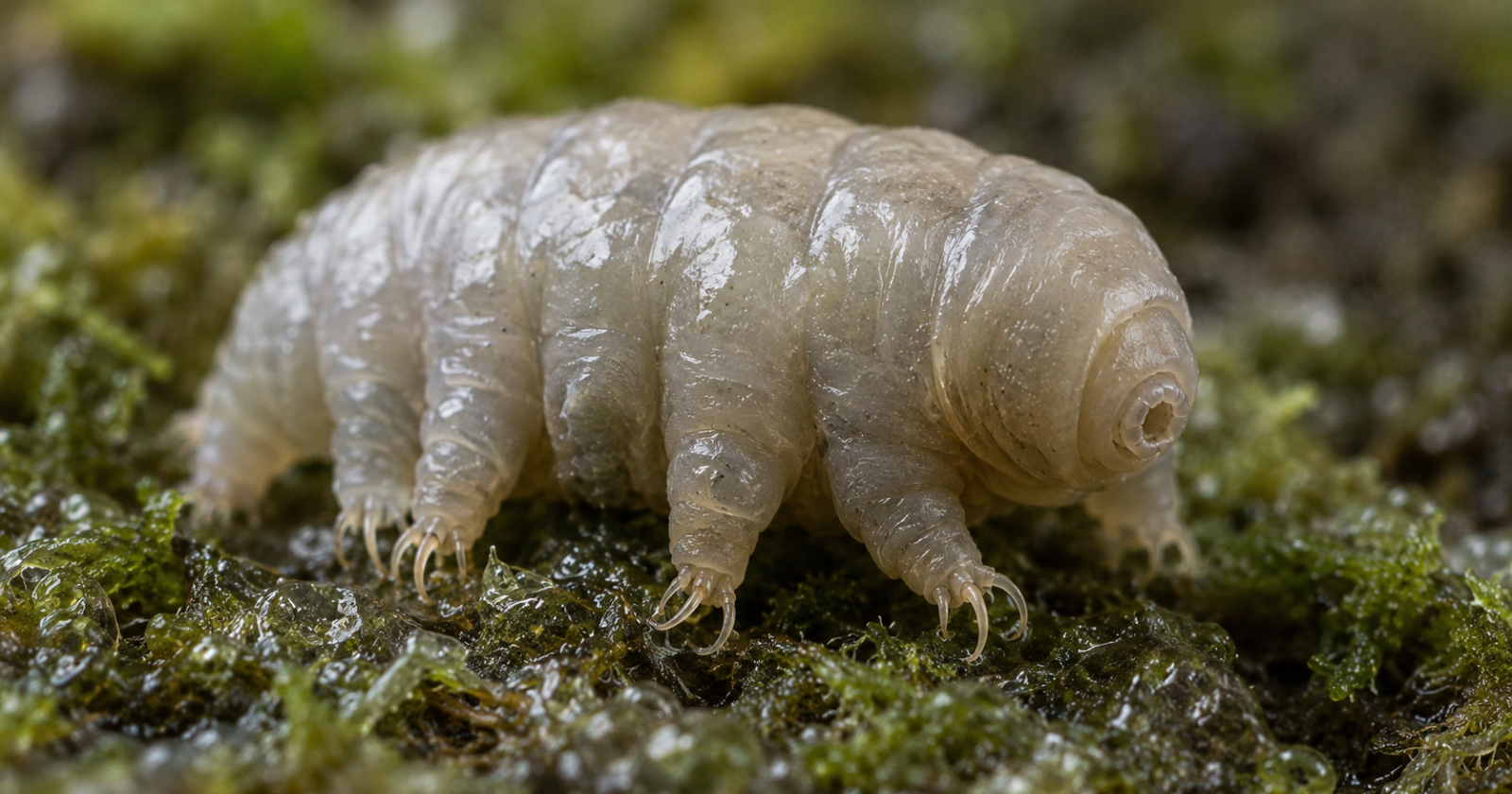
Every living thing has a breaking point. Enough cold ends it. No water for long enough ends it. Enough radiation ends it too, sooner or later, for almost anything alive on this planet. Except, it turns out, for one creature small enough that a dozen of them could fit on the head of a pin, and stubborn enough to keep failing to read the memo.
That creature is the tardigrade, a water-dwelling animal known almost as often by its nickname, the water bear, for the way it lumbers along on eight stubby legs under a microscope. Takekazu Kunieda, an assistant professor at the University of Tokyo’s Graduate School of Science, described just how far its tolerance stretches: “Tardigrades, or water bears, are tiny aquatic creatures that can survive through incredible conditions including temperatures up to 100 degrees Celsius and as cold as absolute zero at minus 273 degrees Celsius, the vacuum of outer space, and extremely high pressures and intense radiation.”
That list breaks down into a few distinct survival tricks, and researchers have spent years picking apart how each one actually works.
1. It empties itself out and waits
The first trick is desiccation tolerance. When its pool or moss patch dries up, a tardigrade pulls its legs in, drains most of the water from its cells, and curls into a dry, shriveled ball called a tun. In that state its metabolism drops to something close to zero. It isn’t really alive in any active sense, but calling it dead doesn’t fit either. Call it paused.
It can stay that way for years, then rehydrate and walk off once water shows up again, which is also the trick that lets it survive the vacuum of space Kunieda described above.
2. It can be frozen solid and thaw out fine
The second trick is cold tolerance, and it overlaps with the first. A body with barely any water left in it has far less ice to form and tear through its own cells, which is part of why tardigrades have been revived after exposure to the same near-absolute-zero cold Kunieda mentioned, a level where most ordinary chemistry simply stops. Whatever the full mechanism turns out to be, the outcome is consistent.
Freeze one, thaw it back out later, and there’s a real chance it just continues on with its day as though nothing happened.
3. It shrugs off radiation that would kill nearly everything else
The third trick, radiation tolerance, is the one that eventually led researchers into a human cell culture lab. Tardigrades can absorb doses of radiation that would be lethal to almost anything else, humans included, and for a long time nobody knew exactly why. The obvious guess was that tardigrades must simply be unusually good at repairing DNA once it’s damaged. That theory made intuitive sense.
Most organisms known for tolerating high radiation, certain bacteria included, do it by getting extremely efficient at patching broken strands back together after the fact. A researcher on Kunieda’s team, Takuma Hashimoto, went looking for the mechanism and found something closer to the opposite.
4. Scientists found the protein responsible, and put it into human cells
Hashimoto identified a tardigrade-specific protein that binds directly to DNA and physically shields it, and named it Dsup, short for damage suppressor. “What’s astonishing is that previously, molecules that repair damaged DNA were thought to be important for tolerating radiation. On the contrary, Dsup works to minimize the harm inflicted on the DNA,” he said. To test that idea outside a tardigrade entirely, his team inserted the gene for Dsup into human cultured cells and exposed both Dsup-carrying cells and ordinary ones to X-rays.
The difference didn’t show up right away. Only after leaving the cells to sit for a while did the gap between the two groups become clear, and cells carrying Dsup ultimately showed roughly 40 percent less DNA damage than cells without it, while still dividing normally afterward.
5. What this actually is, and isn’t, yet
None of this happened inside a living person, or even a living tardigrade. It happened in a dish, under a specific dose of X-rays, in cultured cells engineered to make one extra protein. That’s a long way from a treatment, and the research has already gotten more complicated rather than simpler. A follow-up study found that the same protein protecting those first cultured cells appeared to do the opposite in neurons, increasing DNA breaks instead of preventing them. Dsup isn’t a universal shield. It behaves differently depending on the cell type, which is a completely normal thing for biology to do and a good reason not to get ahead of what the data actually shows.
Researchers are still interested despite the complication, partly because damage suppression instead of damage repair was a genuinely new idea in the field, and partly because how the protein behaves varies so much by tissue that it’s become its own open question rather than a settled one. Whatever ends up being useful about Dsup, it probably won’t be a simple copy-paste fix. Biology tends not to hand those out.
I find that second part almost more interesting than the discovery itself. A small animal survives the worst conditions its environment can throw at it not through some dramatic, one-time transformation, but through a quiet, structural habit sitting in its cells, doing the same unglamorous job over and over. That tracks with something I already believe about most resilience worth having, in animals or in people.
The version that actually holds up rarely looks impressive from the outside. It just keeps showing up, in the same small way, for longer than anyone else bothers to, which is basically the argument I make to myself most days right now, a few weeks into life with a newborn in the house, when the version of resilience on offer isn’t anything dramatic, just getting up again and doing the next unglamorous thing.