Ask most people what happens to a body once the air pressure around it disappears and you’ll hear some version of the same story. You explode. Your blood boils. You’re gone before you’d even register what’s happening. None of that is quite true, and the strangest part is that we know it because a man lived through the closest thing to a real-world test.
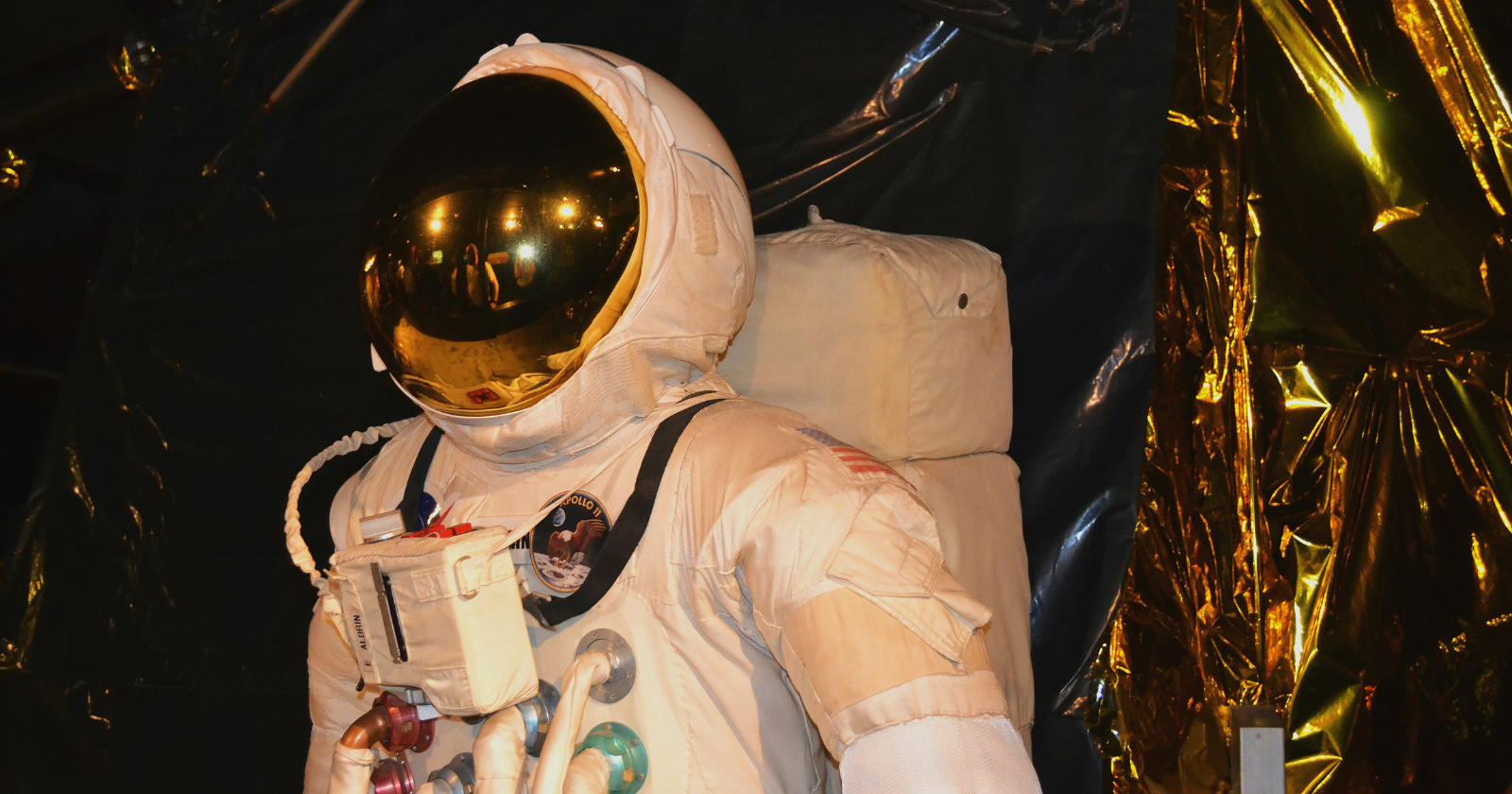
His name was Jim LeBlanc, and on December 14, 1966, he was working inside a vacuum chamber at NASA’s Manned Spacecraft Center in Houston, wearing a prototype of the suit NASA hoped would eventually walk on the Moon. A hose meant to keep the suit pressurized worked loose. Within seconds, the air holding his body together was gone, and the equivalent altitude around him jumped to roughly 120,000 feet, nearly double the point where water starts to boil at your own body temperature. He felt his saliva bubbling on his tongue. Then he blacked out.
He was breathing normally again inside about a minute and a half, and the only injury on record was a sore ear. That detail alone should tell you the myths are wrong. What actually happens is more specific, and more useful to understand, than either the horror story or the miracle.
What actually happened inside Building 7
The test was part of the Apollo program’s long effort to build a suit that could survive the Moon’s vacuum, run out of the Crew Systems Division inside an eight-foot altitude chamber built to fake near-vacuum conditions on the ground. LeBlanc wasn’t an astronaut. He was a suit engineer, pressurized to a modest 3.7 pounds per square inch, sitting inside a chamber that was itself being pumped down toward vacuum, with his suit as the only thing standing between his body and the pressure line above.
Then the umbilical hose disconnected, and a valve meant to seal automatically and hold his air in stayed propped open by the same connector that had just failed. His suit’s pressure emptied almost instantly, and the equivalent altitude around him shot past 120,000 feet. Years later, LeBlanc described the moment in plain terms: “As I stumbled backwards, I could feel the saliva on my tongue starting to bubble just before I went unconscious and that’s the last thing I remember.”
A supervising engineer on the test, Cliff Hess, put the physics of it simply afterward: “Essentially, he had no pressure on the outside of his body and that’s a very unusual case to get.” Two technicians at the chamber controls, watching the pressure gauge fall, started flooding air back into the chamber the moment they saw what was happening.
We actually built a whole video around this exact accident and what it reveals about the ninety-second window that decided the rest of LeBlanc’s life, including the one instinct you’re supposed to fight if you’re ever the one losing pressure, and the very different ending three cosmonauts had five years later, when nobody was standing at a valve to bring their air back in time.
The line where your own spit starts to boil
Boiling depends on pressure at least as much as heat, something a kettle on the stove never quite reveals. Water on your stove needs to reach 212 degrees Fahrenheit before it boils, not because that number is special to water, but because that’s the temperature at which water can finally push back against the air pressing down on it at sea level. Take the air away and the same water boils at room temperature, or lower. Thin it enough and it boils at whatever temperature your own body happens to be running.
NASA has a specific line for where that happens to a human being: an altitude of about 63,000 feet, the point where, in the words of Armstrong Flight Research Center historian Christian Gelzer, the “vapor pressure of water is the same as atmospheric pressure” and any exposed liquid on your body starts to turn to vapor at your own 98.6 degrees. It’s called the Armstrong limit, and a commercial jet cruises at less than half that altitude, close enough that it’s a short climb rather than a different world.
LeBlanc’s accident blew straight through that line and kept going. An equivalent altitude of 120,000 feet put him nearly twice as high as the boiling threshold itself, in the same pressure range astronauts meet on the way to orbit.
The part of the myth that’s true, and the part that isn’t
Here’s where the popular version of this story gets it half right. Your blood genuinely can turn to vapor in a vacuum. Where that happens is the part most retellings miss. Arterial blood, the blood your heart pumps out under real pressure, roughly 120 over 75 millimeters of mercury above whatever surrounds your body, stays too pressurized to boil even in a hard vacuum. The roughly 90 percent of your blood sitting in your veins and capillaries at much lower pressure is a different story, and it can start forming vapor within seconds of a real decompression.
None of that is actually what kills you fastest, though. A full decompression kills primarily through oxygen reversing direction, leaving your blood and diffusing backward into your own collapsed, unpressurized lungs, instead of the other way around. Deoxygenated blood reaches your brain in about ten seconds, which is why loss of consciousness in a vacuum happens on a timer you can almost count on one hand.
Why LeBlanc got to eat lunch that day
LeBlanc lost consciousness within about fifteen seconds of the decompression. He was breathing on his own again, pale but neurologically normal, once the chamber was repressurized within roughly ninety seconds, comfortably inside the window in which restoring pressure to a person in this state still allows a full recovery. That window is the entire story. It’s the difference between an accident that ends in a sore ear and one that doesn’t end at all.
Five years after LeBlanc’s accident, three Soviet cosmonauts, Georgi Dobrovolski, Vladislav Volkov, and Viktor Patsayev, met close to the same physics on their way back from Soyuz 11 without a single one of the advantages LeBlanc had. A valve meant to open only inside the atmosphere fired early during their descent module’s separation, and their cabin began venting to vacuum while they wore no pressure suits at all. They remain the only human beings known to have died in the vacuum of space. What separated their fate from LeBlanc’s was simply whether anyone could reach them before the window closed.
I keep coming back to how little of this story is actually about boiling. The line itself is real, sitting less than 30,000 feet above a route your next long flight might actually take. What actually decides whether you walk away with a sore ear or don’t walk away at all is a stopwatch, and whoever happens to be standing at the controls when it starts running.