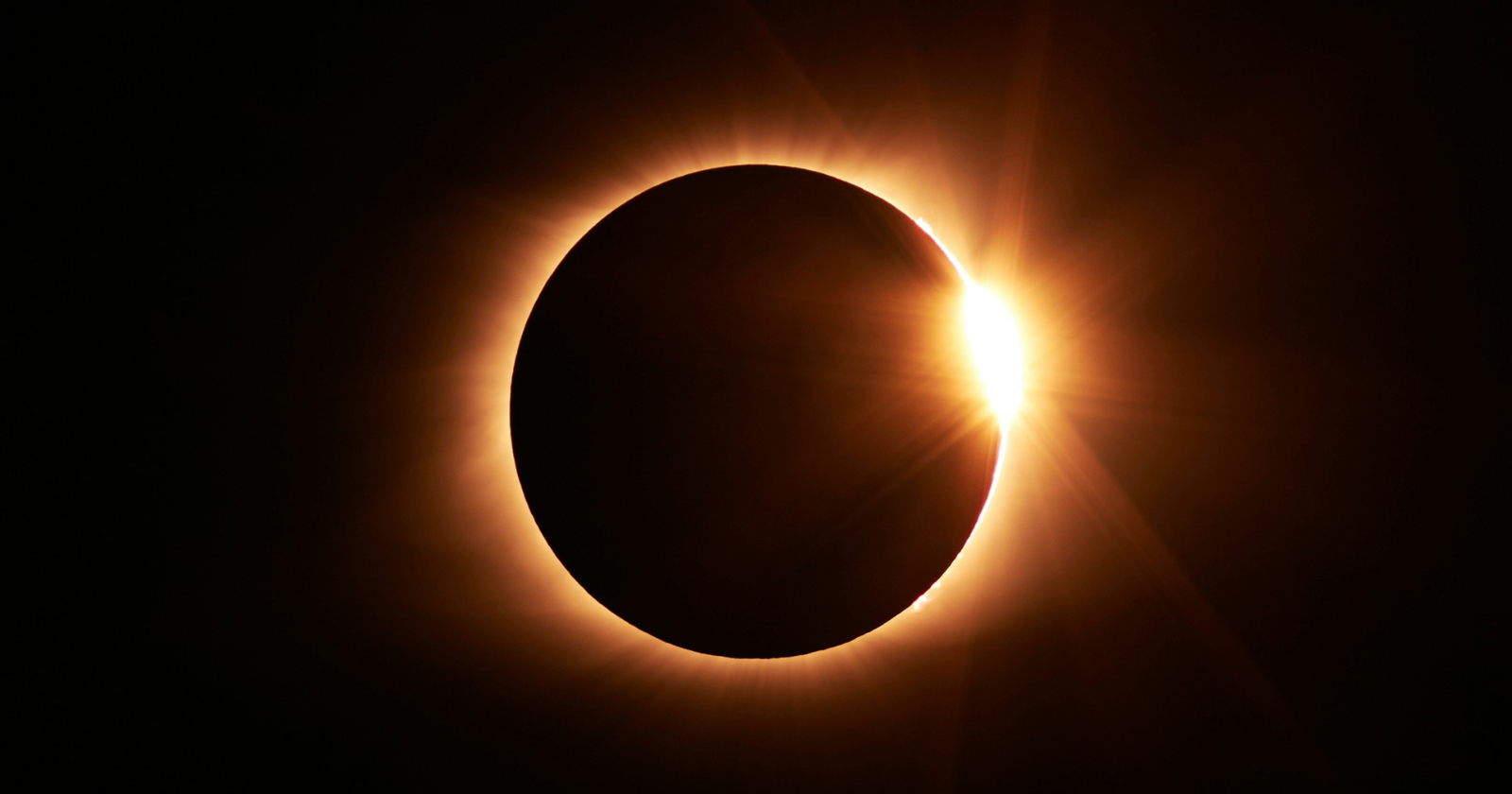
Picture León on the evening of August 12. It’s an ordinary summer evening, the sun taking its usual slow slide toward the horizon while everyone is still out before dinner. Then, over about two minutes, the light drains out of the sky. Streetlamps click on and the air cools a few degrees. Where the sun used to be, there’s now a black disc ringed with a pale, silvery halo, and for a couple of minutes, it genuinely looks like night showed up hours early.
That’s what a total solar eclipse does, and on August 12, 2026, it happens over Greenland, Iceland, and Spain, giving mainland Europe its first shot at totality since 1999. I’ve spent the last few days digging into the details, and there’s more going on here than “the moon covers the sun.” Here’s what’s actually happening, who gets the real show, and how to watch it safely even if you’re nowhere near the path.
Where you actually need to be standing
Totality only happens inside a narrow strip of the Moon’s shadow, and this time that strip is about 180 miles wide, sweeping from Siberia over the North Pole, down through Greenland and Iceland, across the Atlantic, and into northern Spain and a small corner of Portugal. That line is everything.
According to NASA’s timing tables, totality begins around 5:48 p.m. in Reykjavík, lasting around a minute there, then 8:28 p.m. in León and 8:32 p.m. in Valencia, with the longest totality of the whole event, two minutes and eighteen seconds, happening offshore just west of Iceland. Everyone outside that narrow line, across most of Europe, northwestern Africa, and parts of Canada and the northern United States, gets a partial eclipse instead, which is worth seeing but a genuinely different experience.
Why only three countries get the full show
Most total eclipses travel in a fairly straight line from west to east. This one doesn’t. It begins at sunrise on the remote Taymyr Peninsula in Siberia, loops up and over the North Pole, and only then drops back down onto Greenland’s ice sheet, according to the eclipse cartographers at National Eclipse. Because almost everyone in Greenland lives on the western coast while the path crosses the empty eastern side of the island, totality there will pass mostly over research outposts and a handful of cruise ships, largely unwitnessed. By the time the shadow reaches Iceland and then Spain, hours later local time, it has effectively jumped backward across time zones, which is its own odd trick for something that otherwise runs on a fixed, predictable schedule.
That predictability is exactly what makes this kind of darkness feel safe, almost festive. On a related note, the sun does have another way of going dark on us that isn’t nearly so polite about it, the kind that doesn’t wait for an orbit to line up and doesn’t send three years of notice. There’s a video that gets into exactly that, the kind of solar event that can knock out satellites and power grids instead of just briefly blocking a view for two minutes. It’s a genuinely unsettling watch, and worth pausing on if this topic has you curious:
What totality will actually look and feel like
Because this eclipse happens so late in the day across Iceland and Spain, with the sun low over the horizon instead of high overhead, it will look different from most total eclipses people have seen before. In the final minutes before totality, the light takes on a flat, unfamiliar quality that doesn’t read like ordinary dusk. Then, for anywhere from a few seconds up to two minutes and eighteen seconds depending on exactly where you’re standing, the sun’s outer atmosphere, or corona, appears as a pale ring, and because the sun is so close to setting, it should carry a warmer, reddish tint rather than its usual white glow. Stars might pop out briefly. The northern lights won’t, since totality is more of a strange twilight than true midnight darkness.
Why Spain hasn’t seen this in over a century
Spain hasn’t had a total solar eclipse cross its mainland since 1905, according to the European Space Agency, and mainland Europe as a whole hasn’t seen one since 1999. So this isn’t a once-a-decade event. It’s closer to a once-in-several-generations one.
Eduard Masana Fresno, an astronomer at the Institute of Cosmos Sciences in Barcelona, points out that this is actually the first of three. Spain gets a second total eclipse in the south of the country in August 2027, then a “ring of fire” annular eclipse in January 2028. As he puts it, the preparation already underway “is not for just one eclipse, but three.”
The one rule that turns a smudge into a spectacle
Here’s the part that trips people up. A 90 percent partial eclipse and a total eclipse are not the same experience turned down a notch. They’re two different events. Doug Duncan, an astronomer at the University of Colorado who has led eclipse trips since the 1970s, says the biggest misconception people carry into eclipse day is thinking that “if you’ve seen a 90% eclipse, you’ve seen most of the show.” You haven’t.
That’s the cruel irony of this particular eclipse. Madrid and Barcelona will both get a 99.9 percent partial eclipse on August 12, which sounds close enough to count, but in eclipse terms it still equals zero totality. If you want the corona, the darkened sky, and the couple of minutes that make people cry at eclipses, you have to be inside that narrow line, not just near it.
How to watch it safely, wherever you land
If you’re anywhere in the path, even at 99 percent coverage, you need certified eclipse glasses that meet the ISO 12312-2 international safety standard. Ordinary sunglasses do not block anywhere near enough solar radiation, regardless of how dark they look, so they won’t protect your eyes. The only moment it’s safe to look at the sun without protection is during full totality itself, when the moon completely blocks the disk, and the glasses need to go back on the instant the sun starts to reappear. If you don’t have certified glasses, a simple pinhole projector works just as well and never involves looking at the sun directly.
If you’re not traveling anywhere near Greenland, Iceland, or Spain, you can still watch it happen. NASA plans to stream the eclipse live starting at 1:15 p.m. EDT on August 12, and the European Space Agency is running its own broadcast from an observatory in Teruel, Spain, hosted by science communicator Maggie Aderin alongside ESA’s director of science, Carole Mundell. Between the two, there’s a version of this event for anyone with an internet connection, eclipse glasses or not.
Final thoughts
None of this requires a telescope or a physics degree to appreciate. It just requires being inside the right 180-mile-wide strip of the planet during the right two minutes, or failing that, a decent internet connection and a livestream. Either way, on August 12, a large slice of the Northern Hemisphere is going to look up at the same darkened sky at the same time, and that alone doesn’t happen nearly as often as you’d think.