
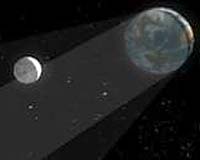
The year 2004 is shaping up to be a memorable one for the Moon. Wednesday night brings us a total lunar eclipse visible throughout the country, while at the same time NASA begins preparations to return to the Moon with its new focus on exploration.
Lunar eclipses are one of the most beautiful and easiest celestial events to witness – just walk outside and look up – no telescopes or special glasses required. During totality, Earth casts a reddish-colored shadow over the Moon lasting over an hour.
“The basic interest in lunar eclipses is that it’s a chance to gauge the quality of the Earth’s atmosphere by judging and making measurements of the coloration of the moon,” said Dr. Fred Espenak, NASA Astronomer.
“If we have major dust storms off the Sahara Desert, big forest fires, or more specifically, a major volcanic eruption which throws lots of material up into the Earth’s stratosphere, this can sharply color and darken the Moon during that total phase.”
Because the active volcanic eruption events at Mt. St. Helens have been largely steam with little ash, Wednesday’s Moon should appear bright and coppery red during totality, between 10:23 and 11:45 pm EDT. For times throughout the U.S., just factor in your time zone.
This month NASA is also working to firm up the design and instruments for the Lunar Reconnaissance Orbiter (LRO). Slated to launch in 2008, the mission is the first in a wave of robotic probes paving the way for human missions no later than 2020.
Its mission is to create high-resolution maps, seek landing sites, and continue to search for water ice and other useful resources.
NASA will use this LRO mission, together with its follow-ons to make key decisions about where the first humans back to the Moon should go, the safety of their landing sites, and what they will do while on the Moon. Human lunar exploration will lay the groundwork and provide a testbed to prepare for Mars and other destinations.
“The Moon is our first step with human explorers back into the realm of Deep Space, and will serve as our ‘natural proving ground’ for the types of exploration activities we want to enable at Mars. LRO is our first new guide to the best sites for humans to begin exploring other worlds, and ultimately to seek information about life beyond Earth,” said Dr. Jim Garvin, NASA’s Chief Scientist.
